
A Secret That Actually Held
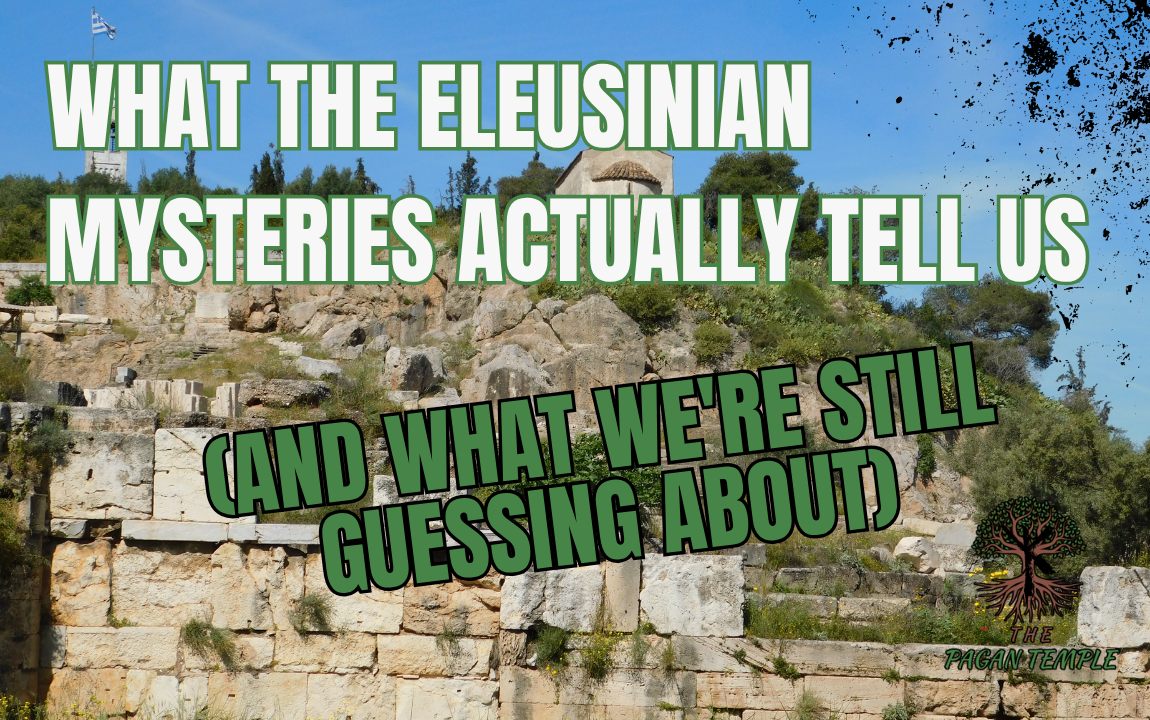
It is worth sitting with how unusual this is. The Eleusinian Mysteries, centered at the town of Eleusis near Athens, operated for over a thousand years, and the core secret of what actually happened during the culminating initiation rite was kept remarkably well the entire time. Revealing it carried the death penalty under Athenian law. Plenty of educated, talkative ancient Greeks who left us enormous bodies of writing on nearly every other topic simply did not write down what happened inside the Telesterion, the hall where the rite took place.
That secrecy is precisely why this topic attracts so much confident online speculation. The mystery invites filling in the blank. Good content resists that temptation and instead tells you clearly what is documented, what is reasonably inferred, and what is genuine guesswork.
What Is Actually Documented
We know the myth that provided the mythological foundation for the rite: the story of Persephone's abduction by Hades, Demeter's grief and search, and the eventual compromise that returned Persephone to the world above for part of the year, narrated in the Homeric Hymn to Demeter. We know the Mysteries were administered as a civic institution by the Athenian state, not a private cult operating outside official structures. We know there was a multi-stage process involving preliminary rites, called the Lesser Mysteries, and a later, culminating Greater Mysteries at Eleusis itself. We know participants drank a ritual beverage called kykeon as part of the process. We know, through archaeology at the Eleusis site, the physical layout of the Telesterion and the general scale of the ritual, since it accommodated a significant number of initiates at once.
What Is Reasonably Inferred
Scholars reasonably infer, based on the mythological foundation and scattered hints in literary sources, that the rite involved some kind of dramatic or experiential engagement with themes of death, loss, and return, echoing the Demeter and Persephone myth. Ancient testimonia, including from writers who were initiates themselves, consistently describe the experience as profoundly transformative and as altering the initiate's relationship to death and the afterlife, even without specifying exactly what was seen or done.
What Is Genuine Guesswork
Here is where a lot of online content gets overconfident. Specific claims about exactly what initiates saw inside the Telesterion, whether there was a literal physical reenactment of the myth, whether visionary or altered states were induced, and what role the kykeon played in producing any altered experience, are all areas of real scholarly speculation rather than settled documented fact.
One notable theory, associated with scholars including Carl Ruck and others working in that vein, proposes the kykeon may have contained a psychoactive substance, possibly connected to ergot, that produced an altered consciousness experience as part of the rite. This is a genuinely interesting hypothesis with some supporting circumstantial evidence, but it remains a theory, not an established fact, and serious classicists are divided on how much weight it deserves. Content presenting this as settled history rather than one contested hypothesis among several is not being honest with you.
Why the Secret Held So Well for So Long
It is worth asking why this particular secret survived more than a millennium when so little else about ancient Greek religious life stayed hidden. Part of the answer is structural. The legal penalty for revealing the rite was death, and Athens enforced this seriously enough that even powerful, well connected figures faced real consequences for crossing the line. Alcibiades, the famous and controversial Athenian general, was accused at one point of mocking the Mysteries by performing a parody of the rite at a private party, and the political fallout from that accusation followed him for years, which tells you something about how seriously this particular boundary was treated even by people otherwise willing to flout social convention.
Part of the answer is also scale and duration working in the secret's favor rather than against it. Hundreds of thousands of people were initiated over the centuries the Mysteries operated, including ordinary citizens, foreigners, and eventually Roman emperors. A secret held by that many people for that long, without ever leaking into a clear surviving written account, suggests the social and religious pressure to maintain it was widely internalized, not just externally enforced by legal threat alone.
A Common Modern Confusion: Lesser Versus Greater Mysteries
Online content sometimes blurs together the Lesser Mysteries and the Greater Mysteries as though they were the same event at different sizes. They were not. The Lesser Mysteries, held in early spring at Agra near Athens, functioned as a preliminary purification stage required before someone could go on to the Greater Mysteries. The Greater Mysteries, held later in the year at Eleusis itself, were the actual culminating initiation, the one involving secret content that carried the death penalty for disclosure. Conflating the two stages makes the overall structure harder to understand and occasionally leads to inaccurate claims about what specific evidence is actually describing, since some surviving references are clearly about the preliminary Lesser stage rather than the secret core of the Greater Mysteries.
Who Actually Went Through This
It is worth underscoring just how broad participation in the Mysteries actually was, since that scale is part of what makes the maintained secrecy so striking. Initiation was open to virtually anyone, citizens and foreigners, men and women, free people and, by some accounts, even enslaved people, provided they spoke Greek and had not committed serious crimes like murder. This was unusually inclusive compared to many other ancient Greek religious institutions, which often restricted participation by citizenship status or gender. Famous historical figures including the philosopher Plato, by tradition, and later Roman emperors including Hadrian and Marcus Aurelius are recorded as having undergone initiation, which tells you this was not a marginal or niche practice. It sat at the center of mainstream ancient religious life for an extraordinarily long time, across a remarkably wide cross-section of ancient society.
Why This Matters Beyond Just Getting the Facts Right
How you talk about the Mysteries says something about your overall approach to this entire tradition. Confidently filling gaps with invented specifics might make for a more dramatic video or blog post, but it teaches people a false sense of certainty about a subject that genuinely resists certainty. The honest version, "here is what we know, here is what we reasonably infer, and here is where real experts still disagree," respects both the evidence and the audience trying to learn from it.
What This Means for Modern Practice
Modern practitioners interested in this branch of practice generally fall into two camps, discussed in more depth on a separate post addressing the secrecy question directly. Some maintain genuine initiatory secrecy within small private practice groups, treating the not-knowing itself as religiously meaningful. Others engage with the documented myth and themes openly, focusing on the Demeter and Persephone story's themes of grief, loss, and seasonal return as a personal devotional and seasonal practice, without claiming to recreate the specific lost ritual content.
For a deeper look at the live debate over whether modern Mystery practice should preserve secrecy, see [link: Should the Mysteries Stay Secret blog post]. For the underlying scholarly source landscape this all sits within, see [link: Chthonic and Mystery Traditions branch page].