Gaulish Polytheism
Education Builds UnderstandingGaulish Polytheism: The Religion of the Ancient Gauls
Gaulish polytheism is the modern reconstructed practice rooted in the religious traditions of the ancient Gauls, the Celtic-speaking peoples who inhabited most of what is now France, Belgium, Switzerland, Luxembourg, and parts of northern Italy and the Rhineland. It is sometimes called Galatibessus, a phrase reconstructed from the ancient Gaulish language meaning roughly "the custom of the Galatae."
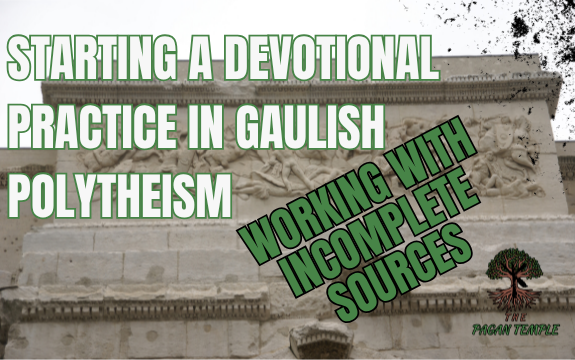
Of all the Celtic branches, Gaulish polytheism is perhaps the most archaeological in character. There is no surviving mythology. No Gaulish equivalent of the Irish epics or the Welsh Mabinogion exists. What we have are stone inscriptions, votive deposits, sacred sites, and the accounts of outside observers, primarily Roman. Working with that material honestly is the foundation of serious Gaulish practice.
Who Were the Gauls?
The Gauls were not a single unified people. They were a collection of related Celtic-speaking tribes, each with their own political structures, local deities, and cultural practices. By the height of Gaulish civilization, roughly 600 BCE to 50 BCE, these tribes had developed sophisticated urban centers called oppida, extensive trade networks, a priestly class (the Druids), and a rich material culture visible in the La Tène archaeological tradition.
The Romans encountered the Gauls first as a terrifying military threat, and later as a people to be conquered and absorbed. Julius Caesar's Gallic Wars (58-50 BCE) ended Gaulish political independence, and over the following centuries, Gaulish culture was progressively Romanized. The result is a complicated historical record, much of it written by the conquerors, but also a significant body of archaeological and epigraphic evidence that the Gauls left behind themselves.
The Gaulish language itself survived long enough to leave hundreds of deity names and ritual inscriptions carved in stone across the former Gaulish world. These inscriptions are some of the most valuable primary sources Gaulish reconstructionists work with today.
The Source Landscape
Understanding what we actually know about Gaulish religion requires knowing where the information comes from.
Roman and Greek literary sources. Caesar's description of Gaulish religion in De Bello Gallico is the most-cited classical source. He famously described the Gauls as worshipping Mercury (most of all), Apollo, Mars, Jupiter, and Minerva, naming Roman equivalents for what were clearly Gaulish deities. This interpretatio romana, the Roman habit of mapping foreign gods onto their own pantheon, obscures more than it reveals. What it does confirm is that the Gauls had a structured polytheistic religion with a recognizable priestly class.
Epigraphy. Stone inscriptions, mostly from the Roman period, record hundreds of Gaulish deity names. Some were local deities worshipped by a single tribe or at a single site. Others appear repeatedly across wide geographic areas, suggesting broader cultural significance. These inscriptions are the closest thing Gaulish reconstructionists have to a primary record in the Gaulish voice.
Archaeology. Sacred enclosures called nemeton, ritual shafts, votive deposits in rivers and bogs, sacred springs, and sculptural evidence all contribute to our understanding of Gaulish religious practice. The material record is substantial. What it rarely provides is explicit narrative or theological content.
Comparative Celtic material. Because Gaulish belongs to the same Celtic language family as Irish and Welsh, comparative analysis of deities, place names, and ritual concepts can sometimes shed light on Gaulish religion. This has to be done carefully and without assuming that what's true in Irish mythology applies directly to Gaul.
The Deities of Gaul
Cernunnos
Cernunnos is one of the most visually iconic deities of the ancient Celtic world. He appears on the Gundestrup Cauldron, on the Pillar of the Boatmen from Paris, and in numerous other artistic representations. He is depicted as a seated, antlered figure, often surrounded by animals, frequently holding a torc and a serpent with ram's horns.
His name comes from a single inscription, but his image is widespread. He is generally understood as a deity of wild animals, liminal spaces, the underworld, abundance, and perhaps the borderlands between worlds. He doesn't map cleanly onto any Roman equivalent, which Caesar largely ignored him, and that's part of what makes him so intriguing to modern practitioners.
Epona
Epona is unusual among Gaulish deities in that she was adopted into the Roman military and religious system and worshipped across the Roman Empire. She is a goddess of horses, mules, and by extension, the journeys, trades, and lives associated with them. Her image typically shows her seated on or between horses, sometimes carrying fruit or grain.
Because of her widespread veneration, more epigraphic and artistic evidence survives for Epona than for almost any other Gaulish deity. She may also carry connotations of sovereignty and the land, though this is partly inferred from comparative Celtic material.
Lugus
Lugus is attested primarily through place names and a small number of inscriptions, but his footprint is wide. The cities of Lyon (Lugdunum), Leiden, and possibly London carry his name. Caesar's claim that the Gauls worshipped Mercury above all others is often interpreted as a reference to Lugus, given the strong parallels between Lugus and the Irish Lugh.
If this identification holds, Lugus was a deity of skill, craftsmanship, commerce, roads, and perhaps sovereignty. The cobbler's guild of Uxama dedicated an altar to the Lugoves, a plural form, which raises interesting questions about his nature and possible triple-deity associations.
Taranis
Taranis is one of the few Gaulish deities named in a classical literary source. The Roman poet Lucan listed him alongside Esus and Toutatis as deities receiving human sacrifice, though this characterization should be treated with some caution given Roman propaganda interests. His name means "thunderer" and he is associated with the wheel symbol common in Gaulish iconography, suggesting a sky or storm deity with possible solar connections.
Esus
Esus appears alongside Taranis in Lucan and is depicted in stone carvings chopping a tree with an axe. The exact nature of his cult is unclear, but his association with trees and woodlands may connect him to the sacred groves (nemeton) that were central to Gaulish religious life.
Toutatis
Toutatis, sometimes spelled Teutates, is a tribal deity whose name means essentially "god of the tribe" or "father of the people." He appears in numerous inscriptions, often equated with Mars or Mercury by Roman interpreters. His name suggests a deity closely tied to tribal identity and communal protection rather than a universal divine figure.
Sirona
Sirona is a healing goddess associated with sacred springs and thermal waters. Her name may relate to the word for star, and she is sometimes depicted with serpents and eggs, symbols of healing and regeneration. She was worshipped at healing sanctuaries in Gaul and the Rhineland and provides a good example of the Gaulish tendency to associate divine presence with specific water sources.
Sucellus and Nantosuelta
Sucellus, the "good striker," is depicted with a long-handled mallet and sometimes a barrel or pot, suggesting connections to abundance, the underworld, and perhaps craftsmanship. He is frequently depicted alongside Nantosuelta, whose name means something like "winding river" or "sun-drenched valley." Together they appear to represent a divine couple with connections to home, hearth, agriculture, and the otherworld.
Rosmerta
Rosmerta is a goddess of abundance and fertility, associated with a wooden bucket or barrel and sometimes depicted with Mercury. Her name means "great provider" or "good purveyor." She represents the prosperity of the land and community, a goddess whose cult centered on plenty and nourishment.
Sacred Practices in Ancient Gaul
The Nemeton
The nemeton was the sacred space of Gaulish religion, typically an outdoor sanctuary in a grove of trees. The word survives in place names across the ancient Gaulish world, from Nemetobriga in Iberia to Nemetacum in northern Gaul. Classical sources describe the Druids conducting rites in woodland groves, and the nemeton concept captures this sacred relationship between divinity, trees, and the natural world.
Some nemeton were elaborated into more formal enclosures over time, but the core idea was always a demarcated sacred space where the human and divine worlds met.
Votive Offerings
The archaeological record is rich with evidence of votive deposits: objects deliberately placed or destroyed as offerings to deities. Weapons thrown into rivers, jewelry buried at sacred springs, miniature objects placed in ritual shafts. The sacred spring at the source of the Seine (Sequana) has yielded thousands of wooden and metal votive objects, including detailed anatomical ex-votos depicting body parts seeking healing.
The logic of votive offering was relational. Something of value was given to the deity, establishing or fulfilling an obligation. This fits the broader Celtic pattern of reciprocity between mortals and divine beings.
Sacred Wells and Springs
Water sources were sacred throughout the Gaulish world, and specific deities were associated with particular rivers, springs, and lakes. The goddess Sequana presided over the Seine. Sabrina over the Severn. Dea Matrona over the Marne. This animist understanding of rivers and springs as divine presences, not just physical features, is one of the clearest threads running through Gaulish religion.
The Role of the Druids
In Gaul, the Druids were not simply priests in the modern sense. They were a learned class responsible for religious ritual, legal judgment, historical preservation, philosophy, divination, and education. Classical sources describe them as holding considerable authority, sometimes mediating between warring factions, and transmitting their knowledge entirely through oral tradition.
The deliberate choice not to write down Druidic teachings is one reason so much is lost. Caesar speculated that this was to preserve secrecy and encourage memory, though the full reasoning will never be known.
The Roman conquest and subsequent persecution of Druidic practice under Augustus and later emperors accelerated the breakdown of this priestly tradition. Druidry as an ancient institution did not survive intact into the modern world.
The Gods in Relation
One of the challenges of Gaulish polytheism is that, without surviving mythology, we don't have narratives showing how the deities relate to each other, what their conflicts and alliances look like, or how they factor into cosmological stories. What we have are snapshots: inscriptions, images, place names.
This means that Gaulish practice requires a different approach than, say, Irish paganism, where you can read the Tuatha Dé Danann interacting in detailed mythological cycles. Gaulish practitioners work with divine presence through direct engagement, archaeology, and careful comparative work rather than through a ready-made mythological framework.
Some practitioners find this liberating. The absence of a fixed narrative means you're working closer to the raw evidence, building relationships with deities through direct practice rather than fitting yourself into a pre-existing story. Others find it challenging and supplement their Gaulish practice with scholarly reconstruction.
Both approaches have merit as long as they're honest about what's documented and what's reconstructed.
Modern Gaulish Practice
Modern Gaulish polytheism has a small but serious practitioner community. Organizations like Galatibessus and dedicated online communities have done substantial work reconstructing Gaulish practice from the available evidence.
Core elements of modern Gaulish practice typically include:
Ritual format. Many practitioners use a structured ritual format centered on sacred fire, offerings, and invocation of deities. The hearth fire, a sacred center in many reconstructed Indo-European traditions, features prominently.
The nemeton. Creating a sacred space, whether outdoors in a grove or as a dedicated indoor area, reflects the ancient Gaulish emphasis on demarcated sacred ground.
Votive offerings. Giving offerings of food, drink, crafted objects, or other items of value to the deities maintains the principle of reciprocity at the heart of Gaulish religion.
Seasonal observance. While the specific Gaulish calendar is partially preserved in the Coligny Calendar, a fragmentary bronze tablet found in France, most practitioners work with some form of seasonal cycle honoring the turning of the year.
Engagement with place. Because so much Gaulish religion was tied to specific sacred landscapes, wells, rivers, and groves, engagement with the natural world and local landscape is a meaningful part of modern Gaulish practice regardless of where you live.
Getting Started with Gaulish Polytheism
If Gaulish polytheism draws you, the single best thing you can do is start reading the primary material, or at least good secondary scholarship that engages with it honestly.
Start with:
- The epigraphic database for Gaulish inscriptions (searchable online through various academic resources)
- Barry Cunliffe's work on the Celts for solid archaeological grounding
- More Gaulish Polytheism Resources
- Alexei Kondratiev's work on Celtic heritage for broader Celtic context
Gaulish polytheism rewards patience and intellectual honesty. The absence of mythology means you build a relationship with these deities from the ground up, through careful study, consistent practice, and genuine engagement with what the ancient Gauls actually left behind.
That's not a limitation. For a lot of practitioners, it's the whole point.