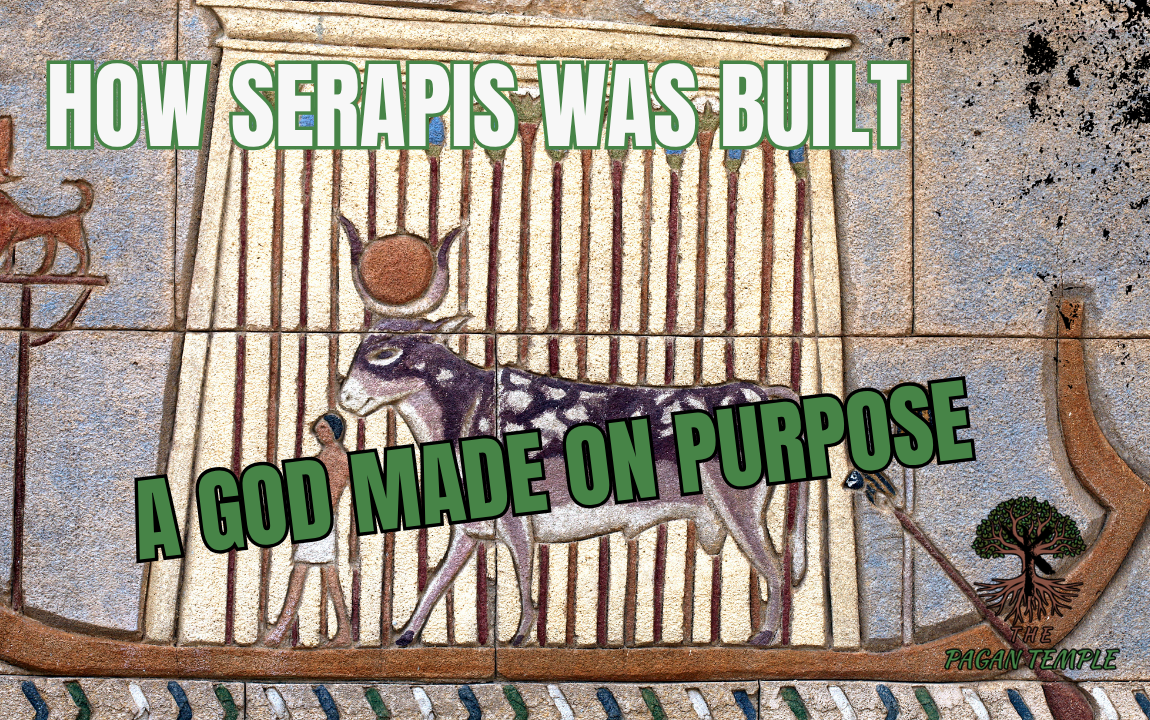

A God With a Documented Origin Story
Most ancient deities have origins lost somewhere in prehistory, accumulated slowly across centuries of local cult practice we can barely trace. Serapis is unusual because we can point to a specific historical moment and a specific political motivation behind his construction as a cult figure.
After Alexander the Great's conquests, the Ptolemaic dynasty took control of Egypt, ruling a population that was overwhelmingly Egyptian while the ruling class and administrative structure were Greek. This created a genuine governance problem: how do you build religious and cultural legitimacy across two populations with deeply different religious traditions?
The Building Blocks
Serapis was constructed from Osiris, specifically in his combined form as Osiris-Apis, or Osorapis, an existing Egyptian funerary and underworld deity connected to the sacred Apis bull cult, merged with visual and conceptual elements drawn from Zeus and Hades. The name itself, Serapis, is a Greek rendering of Osorapis.
This was not a folk religious blending that emerged gradually from ordinary people mixing traditions in daily life, the way some syncretic religious development happens. This was a top-down construction, actively promoted by Ptolemaic rulers, with new temples, the Serapeum most famously in Alexandria, built specifically to house and promote this new combined cult figure.
Why This Particular Combination Worked
Osiris already carried strong associations with death, the afterlife, and royal legitimacy within Egyptian religious tradition, since Egyptian pharaohs were closely associated with Osiris in death. Zeus and Hades, on the Greek side, covered comparable territory: supreme authority and rule over the underworld, respectively. Combining them gave Ptolemaic rulers a religious figure that could function meaningfully within both the existing Egyptian religious framework and the expectations of the Greek ruling and administrative class, without requiring either population to abandon their own prior religious framework entirely.
The Role Egyptian Priests Actually Played
It would be a mistake to picture this purely as Greek rulers imposing a new god on a passive Egyptian priesthood. Egyptian priests, particularly those connected to the Apis bull cult at Memphis, were active participants in shaping and legitimizing the new cult, since their cooperation and religious authority were necessary for Serapis to carry real weight with the Egyptian population rather than reading as an obviously foreign imposition. Ancient tradition credits a priest named Manetho, an Egyptian who also wrote in Greek and is an important source for Egyptian history more generally, with helping advise on the religious details of the new cult's construction, though how much of this specific tradition is reliable historical memory versus later legend attached to a respected name is genuinely unclear.
This collaborative, two-directional quality is part of why Serapis worked better than a purely imposed foreign cult likely would have. It was not Greek religion wearing an Egyptian mask, or Egyptian religion wearing a Greek one. It was a genuine, deliberately negotiated combination, built with input from religious authorities on both sides of the cultural divide it was meant to bridge.
Did It Actually Work as Intended
This is where the evidence gets more interesting than a simple top-down success story. Serapis worship did genuinely spread well beyond its original Ptolemaic political context, eventually appearing across the wider Hellenistic and later Roman world, well outside Egypt and well past the original Ptolemaic political need that produced him. That spread suggests the cult took on a real, organic religious life of its own among ordinary worshippers, beyond the initial top-down political construction.
At the same time, we genuinely have less direct evidence for how an average Greek merchant or an average Egyptian farmer personally understood and related to Serapis day to day, compared to how well documented the top-down royal promotion of the cult is. Good content distinguishes these two things clearly: we know a lot about why and how rulers built this cult, and somewhat less about how it was actually experienced at a popular level, even though we know the popular spread itself was real and significant.
Serapis Outlasted the Dynasty That Built Him
By the Roman period, Serapis worship had spread well beyond Ptolemaic Egypt, reaching Rome itself, where a major temple, the Iseum Campense, served both Isis and Serapis worship in the heart of the city, alongside smaller shrines across the wider empire, often carried by soldiers, merchants, and administrators who had encountered the cult while stationed in or trading with Egypt. Several Roman emperors showed personal devotion to Serapis, and the cult remained religiously significant for centuries after the political circumstances that originally produced it had become a distant historical memory. A god built to solve a specific governance problem in Ptolemaic Egypt ended up with a religious life that far outlived the problem itself, which is its own kind of evidence that the construction, whatever its original political motivation, tapped into something that worked on genuinely religious terms as well.
How Serapis Was Actually Depicted
Visual representation tells its own part of this story. Serapis is typically shown in Greek-style sculpture, bearded, regal, seated on a throne in a pose recognizably borrowed from depictions of Zeus, often accompanied by Cerberus, the multi-headed dog associated with the Greek underworld, and sometimes wearing a modius, a grain-measure headdress connecting him to agricultural abundance and prosperity. This visual language was deliberately legible to a Greek audience familiar with how supreme, underworld-adjacent gods were normally depicted, while still carrying distinctly Egyptian theological content underneath the Greek artistic surface. The combination is a useful visual summary of the whole project: Greek form, Egyptian substance, built to communicate clearly across a cultural divide rather than to obscure it.
What Serapis Teaches Us About Greek Religion More Broadly
Serapis is a useful reminder that Hellenic religion, even in antiquity, was never a sealed, unchanging system. The Hellenistic period saw deliberate, sometimes explicitly political religious construction happening alongside organic popular religious change, often in the same cult at the same time. Modern Hellenic reconstructionism tends to focus heavily on earlier, less syncretic material, but the syncretic Hellenistic period is just as much a real part of this tradition's actual history, political construction and all.