
A Genuinely Remarkable Spread
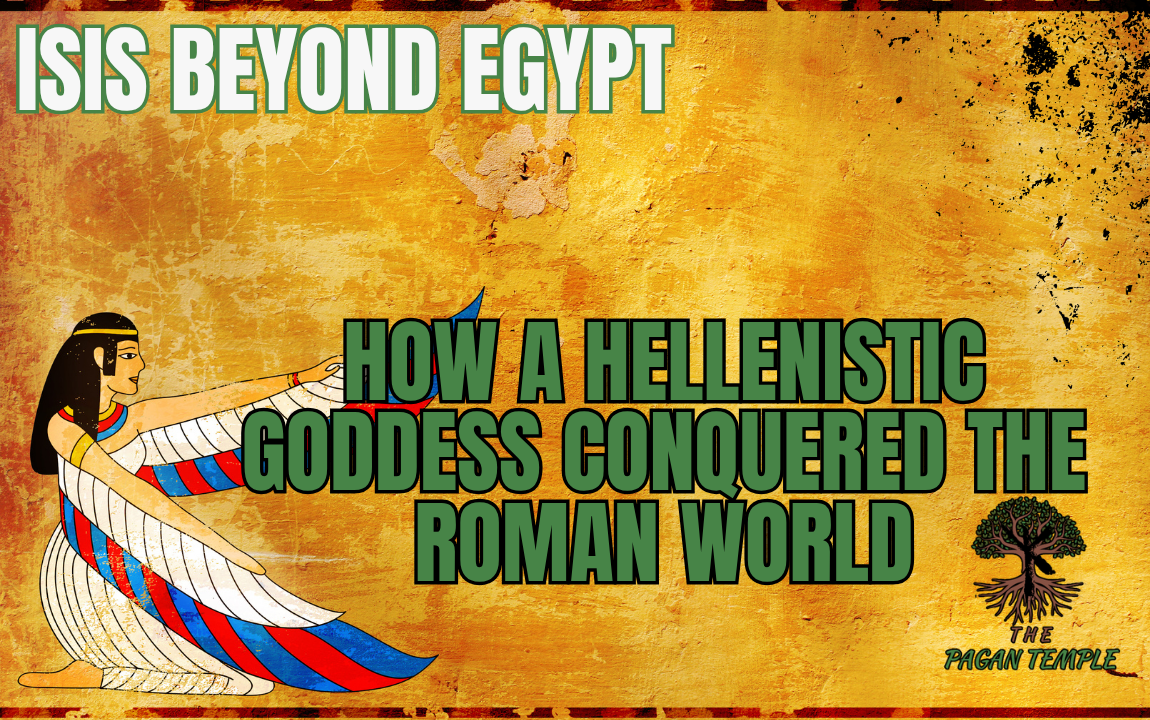
By the height of the Roman Empire, temples to Isis existed not just across Egypt and the eastern Mediterranean, but as far away as Britain, with evidence of her cult at sites including London. For an Egyptian deity to achieve this kind of geographic reach, well beyond the political and cultural context that originally produced her cult, tells us something significant about how religious adaptation actually worked in the ancient world, and this branch of Hellenic religious history deserves serious attention precisely because it shows Greek religion absorbing and being changed by outside influence centuries before modern reconstructionism started doing something analogous in a very different context.
How the Expansion Actually Happened
Isis worship began moving beyond Egypt as Greek-speaking populations and administrators settled across Ptolemaic Egypt following Alexander's conquests, encountering and engaging with existing Egyptian religious structures. As discussed in more depth in the post on Serapis, this period saw significant deliberate, top-down religious construction promoted by Ptolemaic rulers seeking legitimacy across both Greek and Egyptian populations.
Isis worship, however, appears to have spread through a wider range of channels than purely top-down royal promotion. Trade networks, military movement, and ordinary migration all carried her cult outward from Egypt across the wider Mediterranean and eventually into the Roman world, where her worship took on real popular momentum independent of any single political program.
What Made Isis Particularly Adaptable
Isis carried a rich existing theological identity within Egyptian religion: devoted wife and mother through her relationship to Osiris and Horus, powerful magical practitioner, and a deity associated with protection, healing, and resurrection through her role in restoring Osiris. As her cult moved into the Greek and later Roman world, this existing identity proved remarkably adaptable to absorbing additional roles and associations, including connections to Greek deities like Demeter and to broader Mystery-style initiatory religious structures already familiar from Greek tradition.
Plutarch's treatise on Isis and Osiris, part of his Moralia, gives us a direct window into how an educated Greek writer of the Roman period engaged seriously and respectfully with Egyptian theological material, treating Isis's mythology as worthy of genuine philosophical interpretation rather than simply exotic foreign curiosity.
The Mystery Cult Connection
As Isis worship expanded, it took on initiatory elements that drew on the broader Mystery tradition framework already established within Greek religion, including secrecy and structured individual transformation through initiation, discussed in more depth in coverage of the Eleusinian Mysteries elsewhere on this site. This represents another instance of genuine religious blending: a fundamentally Egyptian deity, expressed partly through a structurally Greek religious framework, adapted for new transcultural audiences across the Mediterranean.
Isis Speaking in Her Own Voice: The Aretalogies
One of the more striking pieces of surviving evidence for how this cult presented itself are the so-called aretalogies, inscribed texts written in Isis's own first-person voice, listing her powers and accomplishments directly. The best known example, found at Kyme in Asia Minor, has Isis declaring herself responsible for inventing agriculture, establishing justice, separating earth from sky, and standing above fate itself, among many other sweeping claims. These texts present Isis less as one deity among many with a specific narrow domain, and more as a near-universal divine power who absorbed and superseded the functions of numerous other goddesses across the Mediterranean world.
This near-universal self-presentation is genuinely unusual within the broader hard polytheist framework that shapes most Hellenic religious thought, where deities are normally understood as distinct individuals with specific, bounded domains rather than one goddess claiming authority over essentially everything. Isis worship represents a real theological outlier within the wider Hellenistic religious landscape, and that distinctiveness is part of why her cult attracted so much devoted attention and why it has remained a genuinely interesting case study for historians of ancient religion.
Isis and the Question of Women's Religious Authority
Isis cult sites consistently show evidence of significant female religious leadership, with women serving as priestesses in roles carrying real public religious authority, in a religious landscape where formal female priesthood, while not unheard of elsewhere in Greek religion, was not universally common across every cult. Some scholars connect this to the goddess's own mythological character, devoted wife, powerful magician, and grieving and ultimately triumphant mother, as offering Roman and Hellenistic-era women a religious figure whose central myth directly reflected concerns and life experiences more specific to women than many other major cult figures of the period did.
A Word of Caution About Modern Engagement
If you are drawn to Isis specifically, it is worth engaging carefully and respectfully with the distinction between her original Egyptian cult context, her Hellenistic and Roman-era syncretic cult forms, and modern Kemetic practice, which approaches her from the Egyptian tradition's own continuing modern reconstruction. Treating Hellenistic Isis as simply identical to either the earlier Egyptian goddess or to a generic "goddess archetype" loses the specific, genuinely blended historical character that made her widespread Roman-era worship what it actually was.
Why This History Matters for Modern Hellenismos
The Isis cult's spread is a useful corrective against any assumption that ancient Greek religion was a sealed, unchanging system that modern reconstructionism is simply restoring to some pure original state. Greek religion was already absorbing, adapting to, and being genuinely changed by outside religious traditions well before Christianity ever entered the picture. That adaptability is part of the tradition's actual history, not a departure from it.
This also offers a useful, more comfortable way to think about modern reconstructionism's own necessary adaptations, discussed at length elsewhere on this site. If ancient Greek religion itself was never a static, unchanging system, but was instead constantly absorbing new influences, building new combined cult figures, and adjusting to new political and cultural circumstances across its own long history, then modern practitioners adapting ancient practice to fit twenty-first century life are not betraying some pure, fixed original. They are continuing a pattern of living, responsive religious development that was already characteristic of this tradition in antiquity, long before the modern reconstructionist project began.