
An Evidence Gap Worth Naming Directly
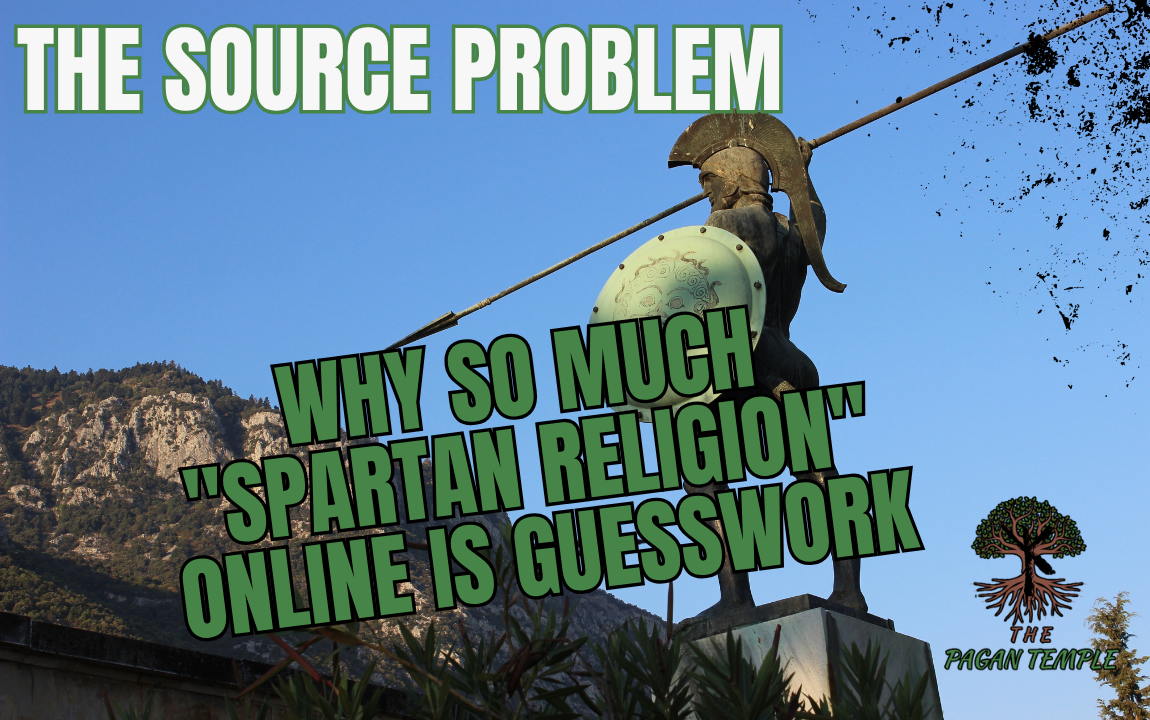
Sparta occupies an unusual position in the study of ancient Greek religion: intense modern popular interest paired with a genuinely thin and heavily biased primary source base. This mismatch is exactly the kind of gap where confident, badly sourced claims tend to spread fastest, because demand for information about Sparta is high while the actual supply of solid evidence is comparatively low.
Why Sparta Itself Left Us So Little
Spartan culture placed a strong value on martial training, physical discipline, and oral tradition, and a correspondingly lower value on the kind of extensive written literary and philosophical output that Athens produced in such enormous quantity. This was not an accident or oversight. It reflects genuine, deliberate cultural priorities, but it means the historical record looking back at Sparta is overwhelmingly written by outsiders.
The Outside Sources We Actually Have
Xenophon's Constitution of the Lacedaemonians is one of our closer-to-firsthand accounts, since Xenophon spent real time in Spartan society. But Xenophon was also an open admirer of Spartan discipline, writing partly to present an idealized case for it, which shapes what he emphasized and likely what he left out or smoothed over.
Plutarch, writing centuries after the Classical period, gives us biographical material on figures like the lawgiver Lycurgus, who is himself a semi-legendary figure whose existence and exact historical role remain genuinely debated among historians. Plutarch was working from sources that were already old, partly legendary, and shaped by centuries of Spartan mythologizing about its own supposedly unchanging ancient constitution, by the time he wrote.
Herodotus and Thucydides, writing from an Athenian-adjacent perspective during or shortly after the period of actual Athenian-Spartan rivalry and conflict, give us politically and militarily focused accounts that touch on religious practice only incidentally, and that come with their own clear biases given the antagonistic relationship between the two city-states during much of this period.
What This Means Practically
When you encounter a confident specific claim about Spartan religious practice online, particularly anything presented with vivid specific detail, a useful habit is asking which ancient source that claim actually traces back to, and whether that source had a documented bias or agenda relevant to the claim. A lot of popular content about Sparta simply repeats earlier popular content without tracing the claim back to its actual ancient origin at all, which means errors and exaggerations compound generation after generation of retelling.
This does not mean we know nothing reliable about Spartan religion. The general existence and basic function of the Artemis Orthia cult and the Hyacinthia festival rest on a reasonable combination of literary reference and archaeological evidence. But specific dramatic details, particularly anything that sounds like it belongs in an adventure novel rather than a historical record, deserve real scrutiny before being repeated as established fact.
A Worked Example Worth Walking Through
One specific, widely repeated claim makes a good case study for how this kind of source checking actually works in practice: the claim that Spartans routinely threw weak or disabled infants off Mount Taygetos, a story that traces back primarily to Plutarch, writing many centuries after the period he is describing, and drawing on sources of uncertain reliability even in his own time. This claim gets repeated constantly online, often presented as settled, well documented Spartan practice.
More recent archaeological investigation at a site identified with the supposed apothetae, the pit associated with this practice in ancient sources, found skeletal remains that were overwhelmingly adult, predominantly adult males, many showing signs consistent with violent death, rather than the infant remains the popular version of the story would predict. This does not necessarily disprove every version of the underlying tradition, but it strongly suggests the site in question functioned primarily as a place of execution for adult criminals or enemies rather than as a routine site of infant disposal as commonly described. This is exactly the kind of case where tracing a popular claim back to its source, and then checking that source against independent physical evidence, produces a meaningfully different and more honest picture than the version that circulates casually online.
A Practical Checklist for Evaluating Spartan Religious Claims
Ask whether the claim traces to Xenophon, who is closer to firsthand but openly admiring and therefore likely to present a favorable picture. Ask whether it traces to Plutarch, writing centuries later from sources already partly legendary. Ask whether archaeological evidence independently supports the claim, which carries more weight than literary description alone. Ask whether the claim is repeated identically across many modern sources without any of them citing a specific ancient text, which is often a sign the claim has drifted from its origin through repeated retelling rather than careful sourcing.
Why This Honesty Actually Helps, Rather Than Hurts, Interest in Sparta
Being upfront about thin and biased sourcing does not make Spartan religious history less interesting. If anything, understanding how thoroughly our picture of Sparta is shaped by outside observers with their own agendas is itself a genuinely interesting historical and historiographical lesson, one that applies well beyond Sparta to how we should approach confident claims about a lot of underdocumented ancient cultures.
There is also a useful broader lesson here about how popular history works in general. The version of any underdocumented ancient culture that ends up dominating popular imagination is often shaped less by the actual surviving evidence than by which later writers had the strongest motivation and the widest audience for telling a particular version of the story. Sparta's popular image owes a great deal to centuries of writers, ancient and modern, using a simplified, idealized Sparta to make a point about their own society's values, whether that point was admiring or critical. Recognizing that pattern does not require abandoning interest in Sparta. It requires reading Spartan history with the same critical attention you would want applied to any heavily mythologized historical subject.