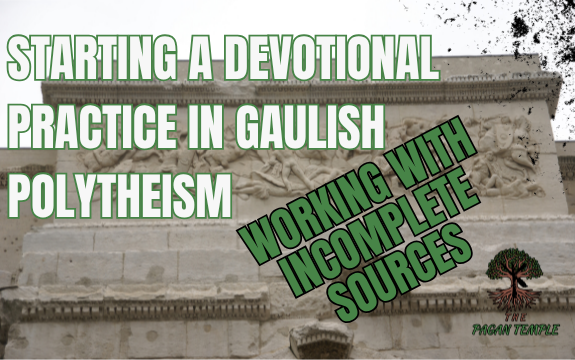

Gaulish polytheism asks something of you that most Celtic traditions don't: it asks you to be comfortable with not knowing.
There is no Gaulish mythology. No equivalent of the Irish cycles, no Mabinogion, no prose narratives that show the gods moving through the world and interacting with each other. What we have are stone inscriptions, archaeological evidence, votive deposits, and Roman accounts written by people who had every reason to get things wrong.
For some practitioners, that's a dealbreaker. They want a mythological framework to orient themselves in, a story that tells them who the gods are and how they relate to each other.
For others, that absence is exactly what makes Gaulish practice compelling. You're working closer to the raw evidence. There's less received tradition to get between you and the deities themselves.
This post is for the second group. Or for anyone curious enough to try.
Understand What You're Actually Working With
Before you build a practice, it helps to have a clear picture of the source landscape. [The full Gaulish Polytheism page](link: Gaulish Polytheism page) covers this in depth, but the short version is:
The most reliable evidence for Gaulish religious practice comes from three sources: Roman and Greek literary accounts (filtered through outsider perspectives), stone inscriptions from the Roman period (genuine Gaulish voices, but brief and decontextualized), and archaeology (rich material record, poor on explicit meaning).
The inscriptions are particularly important for devotional practice because they tell us, at minimum, that specific deities were considered worth making a formal stone dedication to. When you see dozens of inscriptions to Epona or Cernunnos across a wide geographic area, that's meaningful. When you see a deity name in a single local inscription, you're dealing with something more regional and potentially more obscure.
The major Gaulish deities with strong epigraphic or iconographic evidence include Cernunnos, Epona, Lugus, Taranis, Esus, Toutatis, Sirona, Sucellus, Nantosuelta, and Rosmerta. There are hundreds of others attested in fewer inscriptions.
Knowing this landscape before you start lets you make informed decisions about which deities to work with and how much certainty to bring to those relationships.
The Problem with Borrowed Mythology
When practitioners are drawn to Gaulish tradition but find the source material sparse, there's a common temptation: borrow from Irish or Welsh mythology to fill the gaps.
Lugus gets identified with the Irish Lugh, and suddenly you're using Irish mythology to inform a Gaulish practice. Cernunnos gets associated with the Welsh Arawn because both are linked to the otherworld and animals. Connections are drawn, frameworks borrowed, and before long you're not really doing Gaulish practice anymore. You're doing a kind of pan-Celtic practice with Gaulish labels.
This isn't inherently wrong if you're transparent about it. Comparative Celtic studies is a legitimate and valuable field, and careful comparative work can genuinely illuminate Gaulish material.
The problem is when it's done carelessly, without acknowledging that the Irish tradition developed separately from the Gaulish one, that similar deity names or functions don't necessarily mean identical theologies, and that importing narrative from one tradition into another can distort both.
A better approach: use comparative material to generate hypotheses, not conclusions. The parallel between Lugus and Lugh is interesting and worth exploring. It doesn't mean you can simply substitute Irish Lugh mythology into your Gaulish practice and call it solid.
Building a Ritual Framework
Without a mythological framework to draw from, Gaulish practitioners have developed devotional and ritual structures based on what the evidence actually supports. The communities within the broader Galatibessus movement, particularly Bessus Nouiogalation and Toutâ Galation, have done substantial work here that's worth engaging with.
A basic Gaulish ritual framework typically centers on:
Sacred fire. Fire was central to Celtic religious practice broadly, and the hearth fire specifically carries strong evidence across the Celtic world as a sacred center. Most Gaulish ritual frameworks involve fire as the axis of devotional practice, whether an actual hearth, a candle, or an outdoor fire.
A demarcated sacred space. The concept of the nemeton, the sacred enclosure or grove, is well-attested in Gaulish tradition. Creating a physical or symbolic sacred space before ritual reflects this, whether you're working outdoors in a grove or in a corner of your home.
Offering. Votive offering is one of the most archaeologically well-documented aspects of Gaulish religious practice. Food and drink, crafted objects, things of genuine value given to the deity without expectation of return. The principle of reciprocity, the give-and-take relationship between mortals and divine beings, sits at the heart of Gaulish religion as it does across the Celtic world.
Invocation. Calling on specific deities by name, using what language we have, and speaking to them directly. The inscriptions themselves often provide useful language: many include phrases of dedication or petition that can inform how practitioners address the Deuoi (the Gaulish divine beings).
Closing. Formally marking the end of ritual time and returning to ordinary space.
This framework is simple on purpose. Simple structures maintained consistently do more than elaborate rituals performed sporadically.
Working with the Deuoi Without Mythology
Without narrative, how do you build a relationship with a deity whose story you don't know?
The same way you'd build any relationship: through attention, time, and genuine engagement.
Start with a deity whose evidence base interests you. Read everything scholarly available about them. Study the inscriptions they appear in. Look at the archaeological contexts of their worship. Understand what the iconography tells us.
Then begin working with them directly through regular devotion: making offerings, spending time at their altar or in a natural space associated with their domain, speaking to them plainly and honestly.
What you'll likely find is that the relationship has its own character, separate from the analytical knowledge. The deity starts to show up in ways that are personal to you, in the natural world, in dreams, in the texture of daily life. That's not something you construct. It's something you notice.
The absence of mythology doesn't prevent this. It may actually make it more direct, because there's no pre-existing narrative to project onto the relationship.
The Coligny Calendar and Seasonal Practice
The Coligny Calendar is a bronze tablet found in France in 1897 that preserves a Gaulish lunisolar calendar. It's one of the most significant pieces of primary evidence for how the Gauls marked time and, by extension, when religious observances likely took place.
The calendar is divided into months marked as MAT (good) or ANM (not good), with a five-year cycle and intercalary months to reconcile the lunar and solar cycles. It's fragmentary and not fully decoded, but it's enough to work with.
Many modern Gaulish practitioners use the Coligny Calendar as the basis for their seasonal practice, observing festivals at times indicated by the calendar rather than simply using the Irish quarter days (Samhain, Imbolc, Beltane, Lughnasadh) that have become the default across most of modern Celtic paganism.
This is worth exploring if you want your practice to be distinctly Gaulish rather than a Celtic generic. [The four festivals common to all Celtic traditions](link: Celtic Seasonal Altar post) are relevant background, but Gaulish practice has its own calendrical tradition worth engaging with specifically.
Learning the Language
One distinctive feature of serious Gaulish reconstructionist practice is the engagement with the Gaulish language itself.
Gaulish is a reconstructed language. No living speakers exist. But the inscriptions, combined with comparative Celtic linguistics, have allowed scholars to reconstruct a working version of the language that practitioners use in ritual and devotional contexts.
Communities like Bessus Nouiogalation use reconstructed Gaulish vocabulary deliberately, not to show off, but because engaging with the language is a genuine way of connecting with Gaulish cultural identity. Calling the divine beings Deuoi rather than "gods," using reconstructed phrases in ritual, understanding the linguistic roots of deity names, these aren't minor details. They're part of what makes the practice distinctly Gaulish rather than a generic polytheism with Gaulish labels.
You don't need to become fluent in a reconstructed ancient language to start a Gaulish practice. But engaging with the language as your practice deepens is worth the effort.
What Honest Practice Looks Like Here
Gaulish polytheism requires you to hold a specific kind of intellectual honesty that not every path demands.
You have to be clear about what the evidence actually says versus what you're inferring or constructing. You have to acknowledge when you're borrowing from other traditions and say so. You have to resist the temptation to fill every gap with something comfortable and instead sit with what's genuinely unknown.
This isn't a limitation on spiritual depth. It's the condition of spiritual integrity.
The Gaulish tradition lost its mythological continuity because of conquest and cultural suppression. Pretending that loss didn't happen, or papering over it with borrowed material and calling it ancient, doesn't honor the tradition. Engaging with what actually survived, honestly and carefully, does.
For a lot of practitioners, that kind of rigor feels more spiritually alive than working with a complete mythology that requires no critical thinking. If that resonates with you, Gaulish polytheism is worth your time.
Where to Start
If you want to go deeper, these are the most useful starting points:
- Bessus Nouiogalation (nouiogalatis.org) for community and reconstructive framework
- Toutâ Galation (toutagalation.org) for additional Gaulish polytheist resources
- The Galatibessus movement broadly for connecting with the wider Gaulish pagan community
- Barry Cunliffe's The Ancient Celts for archaeological grounding
- Xavier Delamarre's Dictionnaire de la langue gauloise (in French, but indispensable for serious linguistic work)
Related reading:
- Gaulish Polytheism: The Religion of the Ancient Gauls
- How to Build a Celtic Pagan Practice Without a Local Community
- The Sacred Well in Modern Practice