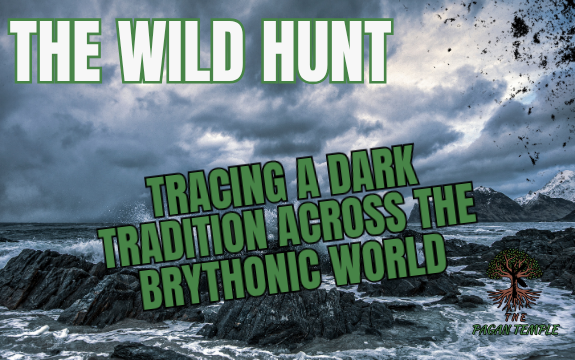

The Wild Hunt: Tracing a Dark Tradition Across the Brythonic World
Something rides across the winter sky.
The sound comes first: hounds in full cry, hoofbeats that don't quite land right, wind that carries voices you can't quite make out. You don't look up. Every tradition that preserves this story agrees on that point. You do not look at the Wild Hunt as it passes.
The Wild Hunt is one of the most widely attested folk traditions in northern and western Europe, appearing in Germanic, Celtic, and Slavic cultures from Scandinavia to the Iberian Peninsula. But the Brythonic Celtic version has its own distinct character, its own figures, its own relationship to the landscape, and its own theology. It is not simply a local variant of a pan-European monster story. It is a specific religious and cosmological tradition rooted in the Welsh and broader Brythonic understanding of the dead, the otherworld, and the nature of divine power.
What the Wild Hunt Is
Across all its European variations, the Wild Hunt follows a consistent structural pattern: a spectral or divine figure leads a procession of the dead, ghostly hounds, or supernatural beings across the night sky, usually in winter, usually at speed. The leader varies: Odin in Germanic tradition, Herne the Hunter in southern English legend, Gwyn ap Nudd in Wales. The company varies: sometimes the recent dead, sometimes ancient warriors, sometimes fairies.
What is consistent is the danger. Seeing the Hunt was understood as a bad omen, a portent of war, plague, or the death of the witness. Being caught by it was worse. Being swept up in it was a form of death or disappearance that the folklore of every culture that preserved this tradition treated with absolute seriousness.
This is not a metaphor. The people who preserved these stories believed, on some level, that the Hunt was real, that it moved across specific landscapes at specific times of year, and that the appropriate response to encountering it was avoidance, propitiation, or getting inside and staying there.
The Brythonic Root: Cŵn Annwn
The Brythonic Celtic wild hunt centers on the Cŵn Annwn, the Hounds of Annwn, and their association with death and the otherworld predates the broader Wild Hunt motif as it developed in medieval European culture.
The Cŵn Annwn are white-bodied dogs with red ears. That specific description, white bodies, red ears, appears in the very first pages of the First Branch of the Mabinogion, when Pwyll encounters Arawn's hunting pack pursuing a stag in the forest. Arawn's hounds are otherworldly before the narrative ever makes that explicit; the color combination alone signals it to anyone familiar with the tradition, because red-eared white animals are the mark of the otherworld throughout Celtic mythology.
The Cŵn Annwn in later Welsh tradition are understood to hunt souls rather than game. They move through the sky at night, their cries audible to those below, and hearing them in full cry is a death omen. The louder and closer the sound, the farther away they actually are, according to some Welsh folk accounts. When you hear them faintly in the distance, they are very close.
This inversion, hearing faintly means immediate danger, is characteristic of how the Brythonic tradition marks the presence of the otherworld: things there work by rules that reverse the logic of the mortal world. The otherworld's loudest sounds are its most distant, its most beautiful spaces are its most dangerous, and its apparent gifts contain their own traps.
Gwyn ap Nudd: The Hunter
The leader of the Welsh Hunt is Gwyn ap Nudd, the king of the Tylwyth Teg (the Welsh fairy folk) and ruler of Annwn. His name means "white, son of mist" or "bright, son of Nudd," and his father Nudd is cognate with the Brythonic deity Nodens and possibly with the Irish Nuadu, the king of the Tuatha Dé Danann who lost and regained his silver hand.
Gwyn appears in the Welsh page as a lord of the dead whose domain is Glastonbury Tor in some traditions, a connection that gives the figure a specific British landscape anchor. In Culhwch and Olwen, he engages in an eternal conflict with Gwythyr ap Greidawl over the maiden Creiddylad, a conflict that is renewed every May Day and will continue until the Last Judgment. The fight between Gwyn and Gwythyr is generally read as a seasonal myth, the struggle between winter and summer for possession of the land's sovereignty.
As Hunt leader, Gwyn is not simply a death figure. He is the force that gathers and marshals the dead, that ensures the otherworldly herd moves through the world on its appointed rounds. His function is not malicious. It is cosmological. The Hunt has to move because the dead have to be conducted, the otherworld has to interface with the mortal world at the right times and through the right channels, and someone has to lead that process.
The 14th century Speculum Christiani preserves a Welsh charm addressed to Gwyn as king of the fairies that reads, in translation: "To the King of the Faeries, and to his Queen: Gwyn ap Nudd, thou who art far in the forest, for the love of your consort permit us to enter your dwelling." The charm reflects a tradition of direct address to Gwyn as a figure whose permission must be sought before entering his domain. He is the gatekeeper of a specific kind of threshold.
The English Variants: Herla and Herne
The Brythonic Hunt tradition extends into English folklore through several figures, the most significant of which are King Herla and Herne the Hunter.
King Herla's story, preserved in a 12th-century Latin account by Walter Map, tells of a king who attended a feast in the underworld and returned to find that hundreds of years had passed. The analogy to Welsh and Irish otherworldly time-dilation stories is direct. Herla and his company cannot dismount without crumbling to dust, so they ride endlessly, making up the Herlathing (Herla's assembly), the English name for the Wild Hunt.
The Herla story is notable because it shows the Hunt emerging from a specific cultural encounter: a mortal king making a transaction with otherworldly beings, getting the wrong end of the deal, and being condemned to perpetual motion as a result. The Hunt in this English tradition is not simply a natural force. It's the consequence of a specific failure to navigate the otherworld correctly.
Herne the Hunter is a later figure, appearing in Shakespeare's Merry Wives of Windsor as a local Berkshire legend, but the underlying folk tradition is older and more serious. Herne is a horned figure, sometimes explicitly antlered, who haunts Windsor Forest and leads a spectral hunt. The horns connect him to a much older tradition of divine antlered figures in the British Isles, and some scholars have argued for connections to Cernunnos, though this remains speculative. What's clear is that Herne represents the Hunt in a specifically English landscape, rooted in specific old-growth forest, specific to a particular royal hunting ground with its own mythological weight.
When the Hunt Rides
The seasonal context of the Wild Hunt is crucial and often misrepresented in popular accounts that reduce it to a generic winter phenomenon.
The Hunt in Brythonic tradition is specifically associated with the liminal periods of the year, and especially with the winter months when the otherworld's boundaries are thinnest. Samhain and the weeks following it are the primary season. The long nights, the movement of the year toward its darkest point, and the general heightening of otherworldly activity that characterizes the dark half of the Celtic year all create the conditions in which the Hunt is most active.
But the Hunt is not limited to Samhain. Walter Map's 12th-century account describes the Herlathing as specifically associated with the Welsh marches and appearing at various times of year. The Welsh tradition of Cŵn Annwn places them in the sky at night throughout the winter season rather than on a single fixed date.
This matters for practice: the Wild Hunt is a winter tradition in the broad sense, not a single-night Halloween event. The entire dark half of the year, from Samhain to Beltane, is the Hunt's proper season.
What the Tradition Is Actually About
The Wild Hunt is not simply a scary story about death. It carries a specific cosmological function that makes more sense when you understand the [relationship between the mortal world and the Celtic otherworld](link: post 10).
The dead do not simply disappear. They move into the otherworldly dimensions of the landscape and remain in relationship with the living community. The Hunt is one mechanism by which that relationship is maintained and regulated. Gwyn ap Nudd gathering the dead and moving them through the sky is not random terror. It's a process of collection and transition, the dead being moved through the liminal space between their departure from the mortal world and their full integration into the otherworld.
The danger of encountering the Hunt comes from that liminality. You are not meant to witness this process any more than you are meant to stand in the path of a river in flood. The force isn't malicious. It simply has no room for bystanders.
The appropriate response, according to folk tradition across the whole range of Wild Hunt accounts, is to get out of the way, to go inside, to cover yourself, and to not look. This is not cowardice. It is correct cosmological behavior.
The Hunt in Modern Practice
Working with the Wild Hunt tradition in modern Brythonic or Gaulish Celtic practice requires respecting what the tradition actually says about it: it is not an invitation to ecstatic outdoor ritual. It is not a time to call the Hunt toward you. It is a time to be aware of what is moving through the world and to conduct yourself accordingly.
Practical engagement with the Hunt tradition might include:
Acknowledging the season as the Hunt's time and behaving with appropriate attentiveness to what that means, being more careful at crossroads after dark, being more deliberate about closing and protecting domestic space during the liminal winter months.
Making offerings to Gwyn ap Nudd at Samhain and throughout the winter season if you work within the Brythonic tradition, acknowledging his role as the one who oversees the movement of the dead. The Welsh charm to Gwyn quoted above gives a starting point for the kind of address the tradition suggests.
Working with the themes of the Hunt as a meditation on death, transition, and the processes that govern the movement of souls through the otherworld, connecting to the broader Welsh cosmological tradition that the Hunt emerges from.
The Wild Hunt is one of those traditions that modern popular paganism has tended to romanticize into something benign and exciting. The original tradition, across every culture that preserved it, understood it as something you respected from a respectful distance. That judgment was probably right.
Related reading: