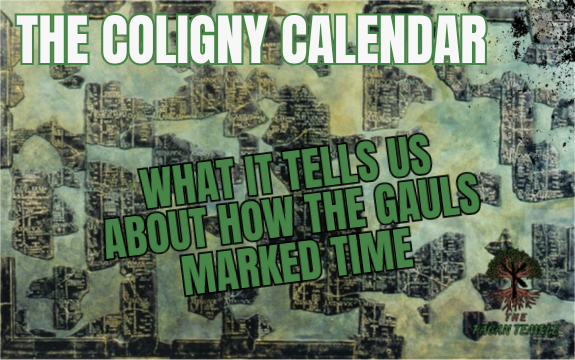

In 1897, a farmer near the town of Coligny in the Ain department of eastern France turned up a collection of bronze fragments. When assembled, they formed a tablet approximately 1.5 meters wide and nearly a meter tall, inscribed in the Gaulish language using Roman capital letters.
What the fragments contained was a calendar: the most important piece of direct evidence for how the ancient Gauls understood and marked time, and one of the longest surviving inscriptions in any Celtic language.
The Coligny Calendar sits in the Gallo-Roman Museum in Lyon. It is fragmentary, about 40 percent of the original survives. It has been debated, reconstructed, and re-debated by scholars for over a century. And for practitioners of Gaulish polytheism, it is a foundational document for building a seasonal practice that is distinctly Gaulish rather than borrowed from the Irish tradition.
What It Is
The Coligny Calendar is a lunisolar calendar: a system that tracks both lunar months and the solar year simultaneously, reconciling the two through a structured cycle.
This is a common solution to a common astronomical problem. The lunar month is approximately 29.5 days. The solar year is approximately 365.25 days. Twelve lunar months add up to roughly 354 days, about 11 days short of the solar year. If you just count lunar months without adjustment, the calendar drifts relative to the seasons, and festivals tied to specific times of year, harvests, planting, animal husbandry, wander out of alignment with the actual agricultural and astronomical reality.
The Coligny Calendar solves this the same way many ancient calendars did: by inserting intercalary months at regular intervals to bring the lunar count back into alignment with the solar year. The calendar runs on a five-year cycle of 62 months, with two intercalary months added to reconcile the discrepancy.
The sophistication of this system is significant. The Gauls were not simply keeping rough track of the seasons. They were maintaining a precise astronomical and religious calendar that required careful observation of both the moon and the sun, and enough mathematical understanding to construct a five-year synchronization cycle.
The Structure
The twelve regular months of the Gaulish calendar are:
Samonios, Dumannios, Riuros, Anagantios, Ogromnios, Cutios, Giamonios, Simiuisonnios, Equos, Elembiu, Edrinios, Cantlos.
Each month is divided into two halves, reflecting the lunar cycle: a bright half and a dark half. The first half of each month consists of fifteen days. The second half is fourteen or fifteen days, depending on the month's length.
The months are classified as either MAT (good, auspicious) with thirty days, or ANMAT (not good, or incomplete) with twenty-nine days. The summer months carry more MAT months: four MAT and two ANMAT in summer, reversed to two MAT and four ANMAT in winter. This structure reflects a religious and cosmological judgment about the quality of time, summer days being categorically more auspicious than winter ones.
Individual days within months are also marked for auspiciousness. Days marked MD (matis diios, "good day") appear on MAT months. Days with different markings indicate neutral or possibly inauspicious timing. The calendar is not just a timekeeping device. It is a religious guide to when specific activities should and should not be undertaken.
Samonios and the Question of the New Year
One of the most debated questions about the Coligny Calendar is what Samonios, the first month, actually corresponds to in the modern calendar.
The name Samonios is generally connected to the Old Irish word "Samhain," which would place it in the late October to early November range. This would mean the Gaulish year, like the Irish year, began at the end of the harvest and the start of the dark half.
However, the Gaulish word "samon" may also mean "summer," which would push the calendar start toward a summer beginning instead.
Scholars remain divided on this, and the honest position for a practitioner is to acknowledge the uncertainty. Most modern Gaulish practitioners work with a Samonios-as-Samhain alignment simply because it produces a coherent seasonal practice and reflects the most defensible scholarly interpretation, but it is not settled fact.
The Dark Half and the Light Half
What the calendar makes clear, regardless of where the year starts, is that the Gauls understood time as divided into a light half and a dark half, with each half carrying different religious and cosmological significance.
This dark-light division is consistent across the Celtic world. [The Irish four festivals](link: post 4) divide the year at the same structural points. The Welsh material reflects a similar seasonal logic. The Cailleach and Brìde in Scottish tradition embody exactly this division in personal, mythological form.
The Coligny Calendar makes it explicit that this division had auspiciousness implications: summer months are more MAT, more auspicious, than winter months. This doesn't mean winter is simply bad. It means it carries a different quality of time, one that demands different kinds of activity, different ritual attention, different relationships with the divine.
The consistent emphasis in Gaulish practice on distinguishing auspicious from inauspicious timing suggests a religious culture in which paying attention to when you did things was as important as what you did. The calendar was the map for navigating that.
The Intercalary Months
The two intercalary months that appear in the five-year Coligny cycle are partially preserved, with names that are fragmentary. The first intercalary month appears before the third year of the cycle, the second before the middle of the fifth year.
French archaeologist J. Monard speculated that the Druids created the Coligny Calendar specifically as a tool for preserving the Druidic tradition of timekeeping during the Roman period, when the Julian calendar was being aggressively promoted as the standard throughout the empire. If that's accurate, the calendar is not just a religious document but an act of cultural resistance: the preservation of a specifically Gaulish way of organizing time against Roman imposition.
The calendar was found broken into over seventy fragments, possibly deliberately destroyed. The bronze statue head found alongside it, likely depicting Mars, suggests it was deposited at a Romano-Gaulish sanctuary. The circumstances of its burial remain uncertain, but the possibility that it was deliberately hidden or destroyed during the Roman suppression of Druidic practice gives the artifact a weight beyond its content.
Why It Matters for Gaulish Practice
For practitioners of Gaulish polytheism, the Coligny Calendar matters for a specific and practical reason: it provides an alternative to the default of using the Irish Gaelic seasonal calendar as the framework for Celtic pagan practice.
The four festivals of Samhain, Imbolc, Beltane, and Lughnasadh, while genuinely ancient and rooted in Celtic tradition, are specifically Irish Gaelic in their names and mythological associations. As noted on the Gaulish Polytheism page, using Irish festivals as the framework for a Gaulish practice is a form of cross-branch borrowing that can blur important distinctions.
The Coligny Calendar, however incomplete and debated, offers a specifically Gaulish framework for seasonal observance. Practitioners working with it can:
Mark the month transitions as observance points, honoring the shift from one month to the next as the calendar does, with attention to whether you are entering a MAT or ANMAT month.
Orient seasonal practice around the calendar's structural dark-light division rather than the Irish festival names, working with the specifically Gaulish understanding of auspicious and inauspicious time.
Engage with Samonios as the threshold of the Gaulish year in its own right, rather than simply treating it as equivalent to the Irish Samhain, acknowledging the uncertainty about exact correspondence while honoring the structural parallel.
Use the calendar as a framework for understanding how the Gaulish worldview organized time, even where the specific ritual content of each period is not known.
What It Doesn't Tell Us
Honesty about the calendar's limitations is important.
We don't know the names of the intercalary months with certainty. We don't know exactly when the calendar year started. We don't know precisely what rituals or observances corresponded to specific months or days beyond the general auspiciousness markings. The calendar tells us that certain times were marked as important and what quality they carried. It doesn't tell us what the Gauls actually did at those times.
That gap, the gap between knowing time was organized in a specific way and knowing what religious practice filled that structure, is one the Gaulish practitioner has to bridge through careful inference, comparative Celtic study, and direct devotional engagement. The calendar is a skeleton. The flesh has to be rebuilt.
For practitioners willing to do that work honestly, acknowledging throughout what is documented versus what is reconstructed, the Coligny Calendar is one of the most valuable and underused primary sources in all of Celtic paganism.
Related reading: