
Why This Question Does Not Have a Clean Answer
"Orphism" gets used online as though it refers to a single, settled, well understood ancient religious movement, complete with specific doctrines about reincarnation, sin, and salvation. The actual current state of academic scholarship is considerably messier than that, and the mess itself is worth understanding rather than smoothing over.
How We Got Here: A Short History of the Debate
Late nineteenth century scholarship, most influentially Erwin Rohde's work, treated Orphism as a coherent and influential religious movement, often described in language that borrowed heavily from how scholars of that era talked about organized religion generally, which in practice usually meant Christianity. This produced descriptions of an "Orphic Church" with sacred scripture, secret adherents, and stable doctrine, language that should immediately raise a flag, since it is importing a specific religious institutional model onto evidence that may not actually support it.
Mid-twentieth century scholarship, particularly Ivan Linforth's influential 1941 study, pushed back hard against this picture, arguing the evidence for a genuinely distinct, coherent Orphic movement, separate from the broader background of Greek mystery religion generally, was weaker than earlier scholars had assumed.
The discovery of the Derveni Papyrus in 1962, along with continued study and expanded discovery of the Orphic gold tablets, gave scholars meaningfully more primary textual material to work with, and prompted a partial rehabilitation of Orphism as a real phenomenon. Walter Burkert's influential work reinstated Orphism as a genuine, though still diffuse, religious tradition, rather than dismissing it as pure modern invention.
The Current Split: Bernabe and Edmonds
Alberto Bernabe, who has produced the major modern critical edition of the Orphic fragments, represents what is often called the maximalist position. Bernabe argues Orphism can be identified as a real religious movement through a recognizable, if not perfectly uniform, set of doctrines concerning the soul, reincarnation, and the afterlife, persisting in identifiable form across a long span of Greek history and geography.
Radcliffe Edmonds, whose 2013 book Redefining Ancient Orphism remains a major reference point for the opposing view, represents a more skeptical, minimalist position. Edmonds argues "Orphic" functioned in antiquity more as a flexible label, applied to unusual or extra-ordinary religious material on a case by case basis to explain strange or non-standard practices, rather than as evidence of one coherent religious movement organized around shared, stable doctrine. On Edmonds's view, looking for a single Orphic "religion" may be asking the wrong question of evidence that actually reflects something more like religious bricolage: practitioners assembling pieces from widely available traditional material to address specific needs.
What Both Sides Actually Agree On
It is worth being clear that this is not a debate over whether the gold tablets, the Derveni Papyrus, or the Zagreus myth material are real and significant. Both Bernabe and Edmonds are working from substantially the same evidence and agree these texts matter. The disagreement is about what kind of religious phenomenon that evidence is actually evidence for: a coherent movement with stable doctrine, or a flexible, opportunistic label applied to varied material that does not add up to one consistent system.
Where the Gold Tablets Actually Come From
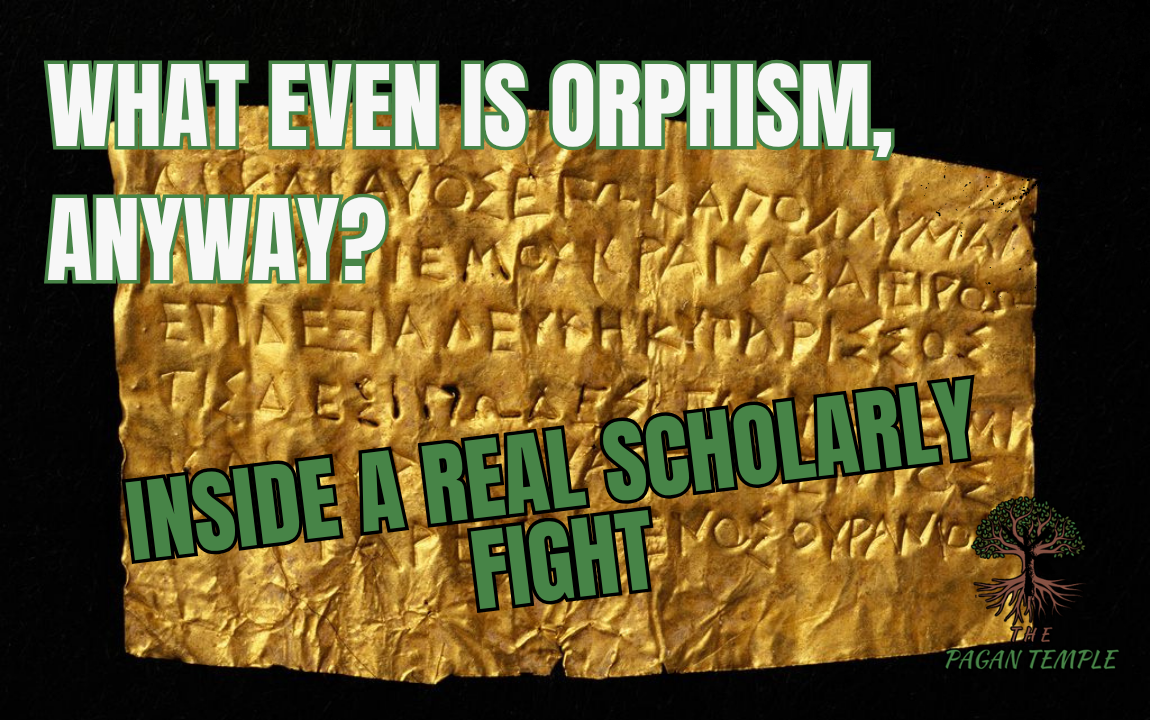
It helps to ground this debate in the physical evidence itself. The Orphic gold tablets are small, thin sheets of gold, often folded or rolled, inscribed with short texts and placed in graves, discovered across a surprisingly wide geographic spread, including sites in southern Italy like Thurii and Hipponion, in Thessaly at Pelinna, and on Crete, spanning a period from roughly the fourth century BCE into the Roman era. The texts found on them vary, some offering the deceased instructions for navigating the underworld, including specific guidance about which spring to avoid drinking from and which to choose, others offering shorter formulaic statements about the soul's divine origin and its release from the cycle of rebirth.
This geographic and chronological spread is itself part of what fuels the debate. Bernabe and other maximalists point to thematic consistency across tablets separated by centuries and hundreds of miles as evidence of a real, if loosely organized, shared tradition. Edmonds and other minimalists point to the genuine variation in specific content between tablets as evidence against assuming one single coherent doctrine was being transmitted uniformly across all that time and distance. Both readings are looking at the same set of roughly forty surviving tablets and drawing different conclusions about what that pattern of similarity and difference actually proves.
A Practical Test for Reading Online Claims About Orphism
Given how contested this material is among specialists, a useful habit when you encounter a confident claim about "what the Orphics believed" online is to ask whether the claim specifies which evidence it is drawing from, a specific tablet, the Derveni Papyrus, a specific later commentator like Olympiodoros, and whether it acknowledges that scholars dispute how representative that specific piece of evidence is of some larger coherent system. Content that presents a single, clean, unified "Orphic theology" without any of that hedging is almost certainly smoothing over a genuine, ongoing academic disagreement rather than reporting settled fact.
Why This Matters Beyond Academic Classifications
How you frame Orphism shapes how you talk about specific myths, specific tablets, and specific modern practices that draw on Orphic-attributed material. If you present Bernabe's framing as settled fact, you are implicitly claiming a level of doctrinal coherence current scholarship genuinely disputes. If you present Edmonds's framing as settled fact, you risk underselling the real, repeated thematic patterns that do show up across this material, which is part of why Bernabe's position has serious scholarly defenders too.
The honest approach, and the one this site uses throughout, is naming both positions, explaining what each is actually claiming, and being clear that current scholarship has not resolved this question, rather than picking a side and presenting it as the only reasonable view.
It is worth adding that this kind of unresolved scholarly debate is not a weakness specific to Orphism. Plenty of well established fields of historical religious study have genuine open questions that specialists actively disagree about decades into serious research, and the existence of disagreement is itself often a sign that the underlying evidence is rich and complicated enough to support more than one defensible reading, rather than a sign that the topic is poorly understood or not worth taking seriously. Treating the Bernabe-Edmonds disagreement as a reason to dismiss Orphism as an unworkable or fundamentally confused category misreads what an active scholarly debate actually signals about a field's health and depth.