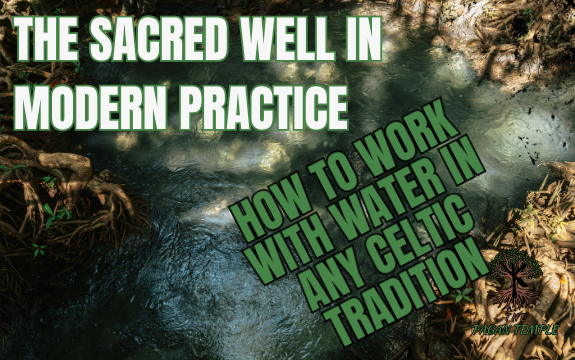

Water is the most consistent thread running through Celtic religious practice.
Not fire, not the seasonal festivals, not even the gods themselves. Water. Every branch of the Celtic world, from the Gaulish inscriptions naming river goddesses to the Irish cosmology centered on sacred wells, from the Scottish Highlands' holy springs to the votive deposits pulled from British rivers and lakes, treated water as a living presence, a place where the divine was immediately accessible.
This wasn't metaphor. The Celts named rivers after goddesses because they understood rivers to be goddesses. The Sequana was the Seine. The Sabrina was the Severn. The Boann was the Boyne. They threw weapons, jewelry, and elaborate metalwork into bodies of water as offerings, not because water was symbolically meaningful, but because real divine beings received those offerings there.
That animist relationship with water is still accessible to modern practitioners regardless of which Celtic branch they work in. This post is about how.
What the Archaeological Record Tells Us
The evidence for sacred water practice in the Celtic world is extensive enough that it's worth spending a moment on it, because understanding what ancient practitioners actually did gives modern practice a more honest foundation.
Votive deposits in rivers, lakes, bogs, and wells have been recovered across the entire former Celtic world. The quality and quantity of objects deposited is remarkable. At the source of the Seine, the sanctuary of Sequana yielded thousands of objects: bronze figurines, wooden anatomical ex-votos depicting diseased limbs, eyes, and organs seeking healing, carved models of pilgrims, coins. These weren't casual offerings. The anatomical ex-votos in particular show a deliberate, specific practice: you came to Sequana's spring with your ailment, you offered a carved representation of the affected body part, and you sought healing from the goddess of the place.
At Bath, the hot spring sacred to Sulis received offerings continuously for centuries, including over twelve thousand coins and numerous curse tablets requesting divine justice from the goddess.
In Britain, the Thames, the River Witham, and Llyn Cerrig Bach in Wales all yielded significant deposits of deliberately placed objects, including weapons, chariot fittings, and personal items. These weren't objects that fell in. They were placed there.
The pattern is consistent: water was a place of real transaction with real divine beings, and people came to it with genuine need.
Sacred Wells Across the Celtic Branches
The specific practice around sacred wells varied across traditions, but the core logic was the same everywhere.
In Gaulish Tradition
The Gaulish world had hundreds of sacred springs, most of them associated with specific local deities. Many became formal healing sanctuaries during the Roman period, but the underlying practice preceded Roman influence.
Sirona, a healing goddess whose name may relate to the word for star, presided over thermal waters in Gaul and the Rhineland. Her iconography, serpents and eggs, reflects healing and regeneration. Practitioners came to her springs seeking physical restoration. As covered on the Gaulish Polytheism page, this practice of venerating specific divine presences in specific water sources is one of the most consistent features of Gaulish religion.
In Irish Tradition
Ireland has an extraordinary density of sacred wells, many of them associated with specific saints who absorbed earlier pre-Christian divine presences. The Christianization of Irish sacred wells is so thoroughgoing that most surviving well traditions in Ireland today have patron saints rather than named pre-Christian deities.
But the practice underneath is recognizable. You visit the well at specific times of year, circle it a set number of times (the number matters, and always clockwise, called "going sunwise" or deiseal in Irish), leave an offering, drink or wash in the water, and sometimes tie a cloth or rag to a nearby tree (a clootie tree). The clootie cloth tradition is particularly significant: the cloth is tied while you hold your petition or ailment in mind, and as the cloth weathers and decays, the ailment or problem is understood to release.
The Tobar Bride (the Well of Brigid) at Kildare and numerous other wells associated with Brigid are among the most continuously venerated water sites in the Celtic world. Brigid's connection to healing wells is part of her larger mythology, which also encompasses sacred fire and smithcraft.
In Scottish Gaelic Tradition
Sacred well veneration in the Scottish Highlands and Islands is documented in significant detail, partly because these practices survived longer there than elsewhere. The Carmina Gadelica preserves prayers and charms associated with well visits, though in Christianized form.
The practice of visiting a well on specific feast days, particularly Là Fhèill Brìghde (Imbolc), Bealltainn, and other liminal calendar points, was common across the Highlands. Offerings left at Scottish wells often included coins, rags, pins, and sometimes food.
In Welsh and Brythonic Tradition
Wales and Britain more broadly have an extensive holy well tradition that blends pre-Christian and Christian layers. The early Christian church's repeated condemnations of well veneration from the 5th century onward are themselves evidence of how persistent the practice was.
Healing wells in Britain were often associated with specific conditions: eye ailments, skin problems, fertility, broken bones. The specificity suggests a sophisticated practical tradition rather than generic veneration.
The Logic of Sacred Water Practice
Understanding why water held this importance makes modern practice more coherent.
Water in the Celtic worldview was liminal, existing at the boundary between worlds. It came up from the earth, from the underworld, from the realm of ancestors and divine beings below. At a spring or well, you were literally at the point where that otherworldly realm met the surface of the mortal world. The veil, to use a familiar modern phrase, was genuinely thinner there.
This is why the healing sanctuary made sense. You weren't just putting medicine on a wound. You were presenting your need at the place where divine presence was most immediately accessible, and entering into a direct relationship with that presence.
It's also why votive offerings at water sites tended to be genuinely valuable things, not trinkets. You gave something of real worth because you were dealing with a real power. The transaction had weight.
Finding Your Water in Modern Practice
You probably don't have a sacred spring associated with a named Gaulish healing goddess in your backyard. That's fine. The tradition points toward something that's more accessible than it might appear.
Every body of water has a presence. Every river, creek, lake, and spring is part of a living watershed system that the animist tradition understands as spiritually alive. You don't have to go to Bath or the source of the Seine to practice water veneration. You have to go to the water nearest you and pay attention.
A few practical approaches:
Find your local water. What's the nearest natural water source? What body of water does your watershed drain into? What's the river or creek you live closest to? Start there.
Learn its name and its history. Many place names in North America and elsewhere preserve indigenous names for water sources that reflect their own traditions of sacred relationship to those places. Knowing those names, and the traditions they come from, is part of treating the land with respect.
Make your first visit an observational one. Go to the water without a specific agenda. Spend time there. Notice what it feels like. What quality of presence, if any, do you sense? This isn't about manufacturing mystical experience. It's about developing actual attentiveness to a specific place.
Begin a practice of regular visits and offerings. Water accepts simple offerings: poured-out water, small amounts of food, flowers, or handmade items that will not harm the ecosystem. (Be thoughtful here. Coins and synthetic materials aren't appropriate for actual waterways. A biodegradable offering or a small amount of clean water poured in with intention is better than a coin that introduces metals to a waterway.)
Mark the liminal calendar points. The four festivals, and particularly Samhain and Beltane as the major threshold points of the year, are times when the relationship between the mortal world and the otherworld is most active. [Visiting your local water source at these times](link: Creating a Celtic Seasonal Altar post) and making offerings with that liminality in mind connects your local practice to the broader seasonal rhythm of the tradition.
Working with a Specific Water Deity
If you want to develop a devotional relationship with a specific water deity rather than or alongside engaging with your local water sources, the Celtic tradition offers many options.
Sequana for Gaulish practitioners. Boann, the goddess of the Boyne, for Irish practitioners. Sabrina for those working in the Brythonic tradition. Clota (the Clyde) for Scottish practitioners. Sinann, associated with the River Shannon and the well of wisdom at its source, for Irish practice.
Sinann's story is particularly worth knowing. In Irish mythology, she approached the well at the source of the Shannon, which contained the sacred salmon of wisdom, seeking the knowledge the well held. The well burst up and drowned her, and the river that formed was named for her. It's one of the Irish tradition's most striking sacred geography myths, and it points to the spiritual significance the Irish placed on rivers as divine presences with their own stories.
You can work with a named water deity even if you don't live near the river or spring associated with them. The relationship is devotional rather than purely geographic. But combining that devotional relationship with genuine engagement with the water sources near you creates a richer and more grounded practice than either alone.
A Simple Well Practice to Start
You don't need an elaborate ritual to begin working with sacred water. Here's a minimal practice that reflects the historical pattern without requiring more than you have:
Go to a natural water source. Take something of genuine value to offer, something you made, something you care about, or food and drink prepared with intention.
Spend a few minutes in silence. Notice the water: how it moves or sits, what it sounds like, what the air smells like near it.
Speak to the presence of the place. You don't need elaborate invocations. Plain, honest language is better. Tell the water why you've come. Make your offering. Ask for what you need or simply offer gratitude for what you have.
Sit quietly for a while longer before leaving.
Do this regularly. At the liminal calendar points especially. Over time, you'll develop a genuine sense of the specific character of the water you're working with.
That's the practice. Everything more elaborate you might add later grows from that foundation.
Related reading:
- Celtic Paganism: A Complete Guide
- Irish Paganism
- Scottish Gaelic Paganism
- Gaulish Polytheism
- Creating a Celtic Seasonal Altar