
Before we get into what to put on a seasonal altar, it's worth being clear about something: the altar is not the practice.
This matters because modern pagan culture has a tendency to make the altar the centerpiece of observance, as if the right arrangement of objects creates the experience by itself. It doesn't. The altar is a physical anchor for a practice that happens in your body, your attention, and your relationship with the divine. If you get the altar right but skip the actual engagement, you have a nice decorative arrangement and nothing else.
With that said, a physical altar does serve a real purpose. It creates a dedicated space that signals to your nervous system that something different is happening here. It holds objects associated with your practice in a way that keeps them present and accessible. And for the seasonal festivals specifically, the act of changing the altar as the year turns is itself a ritual acknowledgment of that turning.
So yes, build the seasonal altar. Just don't mistake it for the work.
Understanding the Four Festivals
The Celtic year is structured around four major festivals that sit roughly between the solstices and equinoxes. These are:
- Samhain (late October/early November),
- Imbolc (late January/early February),
- Beltane (late April/early May), and
- Lughnasadh (late July/early August).
These festivals are sometimes called the "Celtic Quarter Days" or the fire festivals, the latter because all four were historically associated with ritual fire in some form. They divide the year into the dark half, which runs from Samhain to Beltane, and the light half, which runs from Beltane to Samhain.
The most complete documentation for these festivals comes from Irish tradition, which is why they carry Irish Gaelic names in common usage. But evidence for their observance exists across Celtic cultures, with variations in name, emphasis, and specific practice. Scottish Gaelic tradition preserves its own distinct observances for each threshold. The Welsh and Brythonic tradition has its own seasonal character. And Gaulish practice uses the Coligny Calendar as a basis for a specifically Gaulish seasonal framework rather than defaulting to the Irish quarter days.
This guide works from the Irish tradition as the most documented, but where other branches have notable distinctions, those are worth knowing.
Samhain (October 31 / November 1)
Samhain is the most significant threshold of the Celtic year. The end of harvest, the beginning of the dark half, the point where the boundary between the living and the dead is at its thinnest. The ancestors are present and accessible. The Tuatha Dé Danann, in Irish mythology, are especially active at Samhain. The great mythological battles and supernatural encounters in the Irish texts cluster around this feast.
This is not the festival to approach lightly or superficially. It deserves the most serious observance of the year.
What a Samhain altar centers on:
The ancestral dead are the heart of Samhain practice. An ancestor altar, which may be a permanent feature of your practice year-round, becomes the focus at Samhain. Include photographs, heirlooms, or objects associated with your deceased family members and loved ones. If you don't have physical objects, writing names on paper and placing them on the altar is sufficient.
Food and drink placed for the ancestors: whatever they enjoyed in life, if you know. A lit candle for each person you're honoring. Imagery of the thinning boundary between worlds: items associated with death and with the otherworld, seasonal natural materials like dried leaves, late autumn flowers, dark berries.
The colors of Samhain in natural terms are the deep oranges, reds, and browns of late autumn alongside black and white. Keep the aesthetic rooted in the actual seasonal landscape rather than reaching for purely symbolic decoration.
The actual observance:
The altar holds the space, but the observance involves speaking to the dead: naming them, telling them they're remembered, inviting their presence. Setting a place at the table for ancestors, making their favorite foods, leaving a candle lit through the night. Going outdoors at dusk or dawn when the liminal quality of the threshold is most present.
If you have the opportunity to visit the graves of family members, Samhain is the right time.
Imbolc (February 1 / 2)
Imbolc is the first sign of spring in the dark half of the year. The word is related to the Old Irish for "in the belly," possibly referring to the pregnancy of ewes before the lambing season. The landscape is still cold. The light is still short. But something has shifted.
In Irish tradition, Imbolc is the feast of Brigid: goddess of healing, poetry, and smithcraft, keeper of sacred fire and sacred wells. Her mythology is woven deeply into this festival, and even in Scotland, where she appears as Brìde, the festival carries her presence. The Scottish Gaelic tradition has its own distinct Imbolc practices, including the Brìdeog, a ritual figure representing Brìde that was carried from house to house.
This is a festival of thresholds and renewal, of fire in the cold, of the first tentative return of light.
What an Imbolc altar centers on:
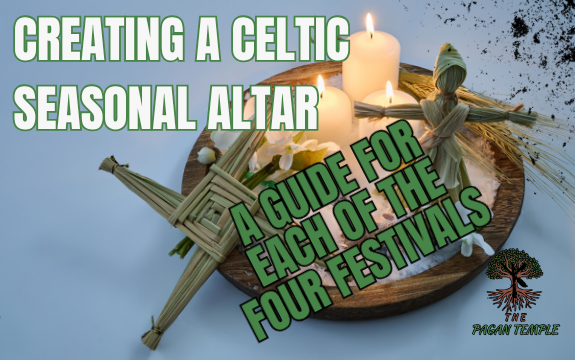
Brigid herself, if you work with her. Her symbols: flame, well, white flowers (snowdrops are traditional in the British Isles, though work with whatever is blooming or stirring near you), a Brigid's cross made of rushes or reeds (the woven reed cross is one of the most documented folk practices associated with the festival), white cloth, milk or cream.
The color palette is white and pale gold: the color of winter light returning, of snowdrops and the first pale green shoots, of milk and flame.
A flame left burning safely through the night at Imbolc reflects the tradition of tending Brigid's sacred fire.
The actual observance:
Making a Brigid's cross is in itself a ritual act. The weaving requires attention and intention, and the finished cross is traditionally placed above the door or hearth for protection through the coming year. Last year's cross, if you made one, is composted or returned to the land.
If there's a sacred well, spring, or other water source you work with, Imbolc is one of the significant times to visit it. Bringing an offering of milk or clean water, circling it sunwise, spending time there.
Lighting a candle before Brigid's image and speaking a simple prayer or intention for what you're calling into the growing light half of the year.
Beltane (April 30 / May 1)
Beltane is fire, vitality, and the opening of summer. The name likely means "bright fire" or "good fire," and bonfires were central to its historical observance. In Ireland and Scotland, cattle were driven between two fires for purification before the summer grazing season began. The protective and purifying quality of Beltane fire runs through every documented version of the festival.
Beltane is also, like Samhain, a liminal threshold. The boundary between the mortal world and the otherworld is thin here too, though in a different register. Samhain's thinning carries the weight of death and the dark. Beltane's is vital, generative, and can be more unpredictable. The sìthiche (Scottish) and sídhe (Irish) folk are especially active at Beltane.
What a Beltane altar centers on:
This is the most visually vibrant altar of the year. Spring flowers in abundance: hawthorn (the blossoming of the hawthorn, or May tree, is one of the most documented signs of Beltane in the British Isles), wildflowers, bright greens. Fire imagery is central. Anything that suggests growth, vitality, and the fullness of the coming summer.
Green and gold and the whites of spring flowers. Natural materials gathered fresh from outside rather than dried or preserved.
A cauldron or bowl of fresh spring water, especially if you have access to water from a natural source, reflects the tradition of gathering dew at Beltane for its purifying and beautifying properties. Beltane dew was considered especially potent in the Highlands and Irish traditions.
The actual observance:
If you can safely light a bonfire, Beltane is the time. Even a candle flame jumped over (carefully) reflects the fire-leaping tradition, though it's largely symbolic at that scale.
Spending time outdoors is essential at Beltane. The festival is fundamentally about the living world in its season of fullness. Go outside, pay attention to what's blooming and growing, make offerings to the land and its spirits.
If you work with any deity particularly connected to vitality, summer, or kingship, Beltane is a significant time for that devotional practice.
Lughnasadh (August 1)
Lughnasadh is the beginning of harvest season, associated in Irish mythology with the god Lugh. The festival's mythology involves a commemorative assembly held in honor of Lugh's foster mother Tailtiu, who died clearing the plains of Ireland for agriculture, giving her life so the land could be productive. The harvest, in this framing, exists at the cost of a life given. There's a weight to it that the festival's modern popularity sometimes misses.
Lughnasadh was historically a festival of games, assemblies, and community, the great gathering at Tailteann in County Meath being one of the important examples in the Irish sources. It was also a time for marriages, trade, and the resolution of legal disputes. The communal dimension of this festival is significant.
The harvest theme is real, but it's worth noting that Lughnasadh marks the beginning of harvest, not its completion. The grain is coming in, but the work is hard and not yet done. The festival's character is one of offering the first fruits in gratitude before the harvest is secured, which gives it a different emotional register than a harvest-home celebration.
What a Lughnasadh altar centers on:
Grain and the first harvest: bread baked from new grain, sheaves of wheat or barley, late summer fruits and vegetables from the garden or market. Lugh's imagery if you work with him: sunlight, skilled craftsmanship, the fruits of skilled labor. Offerings of first fruits placed before whatever deity or spirit you're honoring.
The color palette is gold and amber and the deep greens of late summer. The abundance of the altar should reflect genuine abundance: real food, real grain, real seasonal material.
The actual observance:
Baking bread and making offerings of the first loaf is one of the most accessible Lughnasadh practices. The act of making something by hand and offering part of it before you eat any yourself reflects the festival's logic of first fruits.
If you have a garden, harvesting from it and making a formal offering before consuming any of it is a meaningful observance.
Physical activity has historical roots at Lughnasadh: the games and athletic competitions that marked the ancient festival. A long walk, a swim, any physical engagement with the outdoor world is appropriate.
A Few Notes on All Four Altars
Use what's actually seasonal where you live. The traditional correspondences for each festival come from the British Isles and Ireland. If you live in the American South, the Pacific Northwest, Australia, or anywhere else, your actual seasonal landscape won't match those correspondences exactly. Adjust accordingly. The principle is always to use what's genuinely in season near you, not to import objects that aren't connected to your actual landscape.
Change the altar actively, not just decoratively. The act of dismantling the previous altar, clearing the space, and building the new one is itself part of the ritual acknowledgment that the year has turned. Don't just add seasonal objects to an existing arrangement. Clear it, clean the surface, and rebuild with intention.
Keep it simple enough to maintain. An altar you engage with daily or weekly serves your practice better than an elaborate one you feel too intimidated to touch. Simplicity maintained consistently beats complexity performed occasionally.
The altar is an anchor, not a destination. Take the practice outside, to the water, to the land. The altar holds a space for that practice to return to.
Related reading: