
One of the most common mistakes in modern Celtic paganism is treating the otherworld as an afterlife destination.
It's easy to see why the confusion happens. The otherworld in Celtic mythology is where the dead go, sometimes. Heroes are invited there after death. The Tuatha Dé Danann withdrew there after the Milesians arrived in Ireland. It has qualities associated with paradise: eternal youth, abundance, freedom from illness and suffering. That sounds like heaven.
But it's not. Or more precisely, it's not only that, and treating it as though "afterlife" is the primary or defining thing about the Celtic otherworld misses most of what's interesting and important about it.
The Celtic otherworld is better understood as a parallel realm, adjacent to and interpenetrating the mortal world, accessible to the living as well as the dead, inhabited by divine beings who are actively involved in the mortal world, and operating by rules that differ from ordinary existence without canceling it out.
That's a genuinely different cosmological model than the one most Westerners have been acculturated to, and understanding it changes how you read the mythology and how you practice.
The Irish Otherworld: Many Names, One Pattern
One of the first things to notice about the Irish otherworld is that it has multiple names for multiple dimensions or aspects, and none of them are a simple "land of the dead."
Tír na nÓg (Land of Youth): The most widely known name in popular culture, associated with eternal youth, beauty, and freedom from aging and death. Time moves differently there; years there can equal centuries in the mortal world.
Mag Mell (Plain of Delight): A realm of pleasure, feasting, and beauty, sometimes described as an island beyond the western sea.
Tír Tairngire (Land of Promise): Reached by voyage, a realm promised to the worthy rather than simply inherited by the dead.
Tech Duinn (House of Donn): The dwelling place of Donn, the lord of the dead, to which the dead are said to journey. This is the closest of the Irish otherworldly names to a simple afterlife concept, but even here it's not a place of judgment or reward and punishment. It's a gathering place.
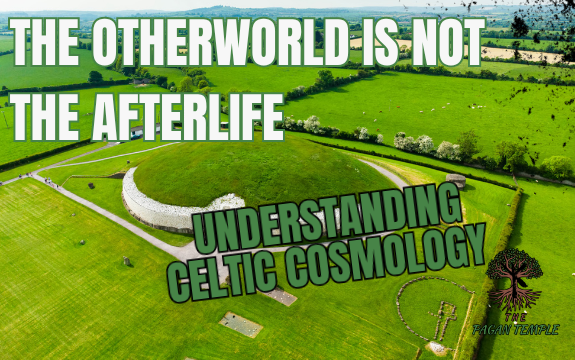
The Sídhe: The sacred burial mounds of Ireland, understood as the dwelling places of the Tuatha Dé Danann after their withdrawal from the visible world. These are specific, located places in the actual Irish landscape, not abstract spiritual destinations.
The plurality of names is significant. The Irish otherworld is not a single, unified place with one function. It has multiple dimensions, multiple modes of access, and multiple relationships to the mortal world. Some parts of it are paradisiacal. Some are perilous. Some are where the dead go. Some are where the gods live. Some are accessible by boat across the western sea. Some are entered through burial mounds at the right time of year.
What connects all of them is the idea of a realm that exists alongside the mortal world, not above it or below it in a strict hierarchy, but in a lateral relationship with it.
The Welsh Otherworld: Annwn
The Welsh otherworld is Annwn, sometimes spelled Annwfn, and its name is usually interpreted as meaning "deep" or "the inner world," suggesting a hidden layer of reality rather than a distant destination.
The poem Preiddeu Annwn (The Spoils of Annwn) in the Book of Taliesin describes Arthur's raid on Annwn to retrieve a magical cauldron. The cauldron that will not boil the food of a coward sits in Annwn, and only seven of Arthur's men return from the expedition. The description of Annwn in this poem is of a place of mystery, danger, and extraordinary power, not a comfortable afterlife destination.
In the First Branch of the Mabinogion, Arawn's realm is portrayed as a court of beauty and feasting. Pwyll lives there for a year in Arawn's form, governs its people, and participates in its life. He encounters it as a functioning kingdom with its own politics and social structure, not as a shadowy realm of the dead.
What the Welsh material is consistent about is that Annwn is not simple. It's strange, beautiful, potentially dangerous, and governed by its own rules. Like the Irish otherworldly realms, it is a parallel reality with its own integrity, not a mirror or shadow of the mortal world.
It's Not Vertical
One of the most useful shifts in understanding Celtic cosmology is to stop thinking vertically.
Most Western cosmological frameworks inherited from Christianity or filtered through it are vertical: God or the divine is above, the mortal world is in the middle, the underworld or hell is below. The afterlife is reached by going up (to heaven) or down (to hell or purgatory). Spiritual progress is understood as ascent.
The Celtic otherworld doesn't work this way.
Access to the otherworld in the mythology is lateral: you sail west, you enter a sídhe mound, you walk through a mist, you are invited in by an otherworldly being. The otherworld is not above or below the mortal world. It is beside it, behind it, accessible through liminal spaces and liminal times.
This is described in modern scholarship as a lateral cosmology: the otherworld exists in a different relationship to ordinary space and time, accessible through specific thresholds, but not located in a different stratum of reality. It is more real than the mortal world in some sense, the intensified version of this world rather than a compensation for it, but it is not geographically above or below.
The three realms of Irish cosmology, land, sea, and sky, also reflect this lateral thinking. They are three modes of existence in horizontal relationship to each other, each with its own divine governance and character. The otherworld interpenetrates all three rather than being a separate stratum located outside them.
It's Accessible to the Living
This is perhaps the most important difference between the Celtic otherworld and the Christian afterlife concept.
The Celtic otherworld is not exclusively the destination of the dead. Living heroes and mortals access it regularly in the mythology.
Pwyll lives in Annwn for a full year. Cú Chulainn visits otherworldly realms and returns. Fionn mac Cumhaill and his warriors encounter otherworldly beings and landscapes repeatedly. Bran mac Febail, in the Irish immram (voyage tale) tradition, actually sails to Tír na nÓg and lives there for a time before returning.
The Tuatha Dé Danann, living in the sídhe after their withdrawal from the visible world, regularly interact with mortals. The Dagda's cauldron is accessible to the worthy. Manannán mac Lir appears to mortals and guides them. The whole relationship between the divine beings of the otherworld and the mortal community is an ongoing, active one.
The key mechanism for otherworldly access during life is liminality: certain times (Samhain, Beltane, thresholds of all kinds) and certain places (burial mounds, crossroads, the edges of water, places of mist) where the boundary between the mortal world and the otherworld is thin enough to pass through. This is not accidental access. The tradition understood specific places and times as genuine thresholds, and treated them accordingly with ritual, caution, and respect.
The Dead Are Not Gone
Within this cosmological framework, the understanding of what happens after death is also different from the Christian model, though the Celtic tradition does not offer a single, unified theology of death across all branches.
What the tradition is consistent about is that the dead are not gone. They are present in the otherworldly dimensions of the landscape, accessible at liminal times, particularly Samhain. The ancestral dead are a living community that persists and remains in relationship with the living.
This is why ancestor veneration is central to Celtic pagan practice rather than peripheral to it. The dead are not departed relatives to be mourned and remembered. They are a continued presence with whom relationship is maintained through regular ritual acknowledgment, offering, and attention.
The Samhain tradition of leaving food out for the ancestors, of acknowledging their presence at the feast, of keeping a candle lit to guide them reflects this understanding. The dead come home at Samhain not as ghosts or spirits in the Halloween sense, but as members of a community whose relationship with the living persists across the boundary that death marks.
Time Moves Differently
One of the most consistent features of otherworldly visits in Celtic mythology is the time dislocation that occurs on return. Oisín returns from Tír na nÓg to find that three hundred years have passed in Ireland while he spent what felt like a few years in the otherworld. Bran mac Febail's crew sends a man ashore who instantly crumbles to centuries-old dust.
This is not simply a narrative device for dramatic effect. It reflects a genuine understanding that the otherworld operates by a different relationship to time than the mortal world. The "eternal youth" of Tír na nÓg is not simply the absence of aging. It's the absence of mortal time altogether.
For practice, this matters in a subtle but significant way. The otherworld is not the past, even though many of its inhabitants include ancestors and ancient beings. It exists outside mortal time. Encounters with it are not nostalgic visits to what was. They're encounters with a mode of existence that is present right now, here, accessible through the places and times where the boundary thins.
What This Changes in Practice
Understanding the otherworld as a lateral, living realm rather than an afterlife destination shifts several things about how Celtic pagan practice makes sense.
Ancestor veneration is not about maintaining connection to the dead at a distance. It's about maintaining right relationship with a present community that happens to exist on the other side of a threshold.
Engaging with sacred landscape is not symbolic. The sídhe mounds, the sacred wells, the threshold places in the natural world are actual points of contact with the otherworld, not just pretty spiritual metaphors.
The divine beings of the Celtic tradition are not absent, historical, or mythological in the sense of being fictional. They withdrew from the visible world but they are still present in the otherworld that interpenetrates it. The Tuatha Dé Danann are in the sídhe. The relationship between them and the living community is not a past-tense thing.
And Samhain is not Halloween. It's the point in the year when all of this, the presence of the otherworld, the accessibility of the dead, the active involvement of divine beings in mortal affairs, comes closest to the surface. Treating it accordingly is one of the most important things a Celtic pagan practitioner can do.
Related reading: