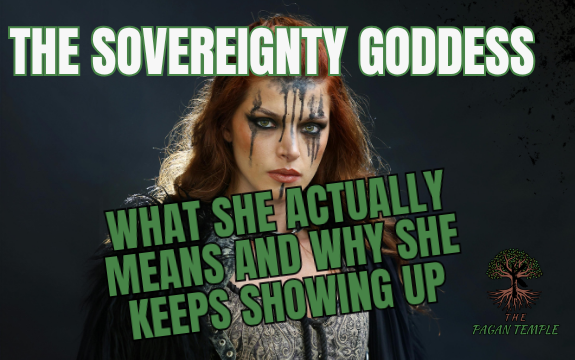

She shows up in Irish mythology more than almost any other figure. She's at the gates of kingship in one story. She's a hag who becomes a beautiful woman in another. She's a queen who demands that her husband prove himself capable. She's a goddess standing in a river ford, washing the arms of the men about to die in battle.
She goes by different names: Ériu, Medb, the Morrigan, Rhiannon, the Cailleach, the Loathly Lady. She's been called the sovereignty goddess, and that phrase has both clarified and confused how modern practitioners engage with her.
This post is about who she actually is, what the concept of sovereignty really means in a Celtic religious context, and why she keeps showing up everywhere once you know what you're looking at.
What Sovereignty Actually Means Here
The modern English word "sovereignty" tends to mean political independence or self-governance. That's not what it means in the context of Celtic mythology.
In the Irish and broader Celtic tradition, sovereignty in this theological sense refers to the right relationship between a ruler and the land he governs. It's not a political status. It's a sacred and relational one. The king doesn't simply hold power over territory. He is bound in a ritual and spiritual marriage to the land itself, embodied as a goddess. If that relationship is right, the land is fertile, the cattle produce, the harvests come in, the community thrives. If that relationship is broken, through the king's dishonesty, physical imperfection, moral failure, or unworthiness, the land suffers.
The sovereignty goddess is the land. She tests, she chooses, she bestows, and she withdraws. She is not simply a consort or a prize. She is the active agent who determines whether kingship is legitimate.
That distinction matters because it fundamentally changes what the "hag who becomes beautiful" stories are actually about. The hag transformation isn't a reward for the hero's open-mindedness or bravery. It's the land itself responding to the recognition of a king worthy of ruling it. When Niall of the Nine Hostages kisses the old woman at the well in the Irish tale, and she transforms into a beautiful woman who identifies herself as the sovereignty of Ireland, the transformation signals that he has correctly understood the bargain. The land recognizes him. He has earned the right to rule.
The Scholarly Debate
Before going further, an honest note: "sovereignty goddess" is a scholarly analytical category, not an ancient Celtic religious title. It's a term developed in Celtic studies in the 20th century, and while it's useful for identifying a pattern that genuinely runs through the material, it has also been criticized for overextension.
The Wikipedia article on sovereignty goddesses puts it plainly: the concept has sometimes led to the attempt to read every strong female character in Welsh and Irish mythology as a sovereignty goddess, which flattens genuine distinctions between very different figures. Not every powerful goddess in the Celtic tradition is a sovereignty figure, and treating the category as a catch-all does a disservice to the actual complexity of the material.
So: the pattern is real and extensively attested. The specific figures are more complex than any single analytical label captures. Keep both of those things in mind as you work with this material.
The Irish Sovereignty Goddesses
Ireland is where the sovereignty concept is most developed and most explicitly documented.
Ériu, Banba, and Fódla
Three daughters of Ernmas in the Lebor Gabála Érenn, and their names are synonyms for Ireland itself. When the Milesians (the mythological ancestors of the Irish people) arrive to claim Ireland, they encounter each of these three in turn. Each asks that the island be named for her in perpetuity. Ériu's name survives in the modern Irish name for Ireland: Éire. These three are sovereignty goddesses in the most direct sense: their names are the land.
Medb
Medb of Connacht is one of the most complex figures in the Ulster Cycle, and her complexity resists easy categorization. She is a queen who chooses and abandons her own husbands, who fights her own wars, who owns her sexuality as an instrument of political power. She is aggressive, manipulative, fearless, and utterly determined.
She is also connected to the figure of Medb Lethderg, the sovereignty goddess of Tara, who is said to have been the ritual consort of many high kings of Ireland in succession. The connection between the mythological queen and the cultic sovereignty figure at Tara is debated, but the parallel is striking.
Medb is not simply a character in a heroic narrative. She embodies what sovereignty demands of a ruler: she tests them, and those who cannot meet her demands are not worthy of the land she represents.
The Morrigan
The Morrigan is the most complex and least easily categorized of the Irish sovereignty figures. Her relationship with kingship runs through the Second Battle of Mag Tuired, where she appears to the Dagda before the battle, mates with him at the ford of the Unius River, and promises to bring the head of the Fomorian king to him. She is actively ensuring the legitimacy and victory of the rightful ruler of the Tuatha Dé Danann.
Her relationship with Cú Chulainn in the Ulster Cycle inverts this dynamic in a way that makes it even more revealing. She offers him her love and her aid. He rejects her without recognizing who she is. And the cycle of her testing, opposing, warning, and ultimately lamenting him that follows is not simple revenge. It's the sovereignty goddess working on a hero who was never going to be king because he could never fully meet the terms of the sacred bargain.
The Morrigan's role in washing the arms of the soon-to-die before battle is another dimension of this: she presides over the threshold between legitimate kingship and its dissolution. She is present at beginnings and at endings.
The Welsh Material
In Welsh tradition, Rhiannon is the clearest sovereignty figure. She arrives on the scene of the First Branch of the Mabinogi on horseback, impossible to overtake until she chooses to stop. Her name connects to a Gaulish goddess name meaning "great queen." Her unjust punishment and patient endurance, and her eventual vindication, tracks the sovereignty pattern in a way that scholars have analyzed extensively.
The key sovereignty test in her story is less dramatic than the Irish hag transformation, but it's present: she must be recognized and courted on her own terms by a man worthy of her. Pwyll's persistence and patience, his willingness to pursue her on her terms rather than through force, is what earns him the right relationship with the sovereignty figure of Dyfed.
Sovereignty figures in the Welsh material tend to be less explicitly theological than their Irish counterparts. The scholar Britta Irslinger has argued that Welsh and Irish female characters whose names relate to ruling or the supernatural likely originate as sovereignty goddesses, but the Welsh material is less transparent about the underlying cultic logic than the Irish.
The Cailleach and the Seasonal Dimension
The Cailleach of Scottish Gaelic tradition adds a seasonal dimension to the sovereignty concept that is worth paying attention to.
In some Scottish accounts, the Cailleach governs winter, and Brìde or the young woman of spring marks summer. The old hag of winter is transformed into, or is supplanted by, the young woman of the growing season. This maps the sovereignty goddess concept onto the agricultural cycle in a way that makes the land's fertility directly legible as the outcome of the sovereignty relationship.
The seasonal hag-to-maiden transformation is a motif that runs through multiple Celtic traditions and is one of the clearest bridges between the sovereignty theology and the animist understanding of the land as a living being with its own cycles.
What the Sovereignty Goddess Is Not
Modern pagan engagement with sovereignty goddesses is sometimes less precise than the tradition warrants.
She is not simply a "triple goddess" in the Wiccan sense of maiden, mother, and crone. The Irish tradition does have triple goddess groupings, but the sovereignty pattern is not reducible to that framework.
She is not a passive symbol of the land. She is an active agent who tests, chooses, grants, and withdraws. The mistake of making her into a beautiful backdrop for the hero's story misses everything important about what she's doing.
She is not always friendly. The sovereignty relationship in Celtic mythology is demanding, conditional, and sometimes brutal. Meeting her terms requires genuine worthiness. Failing to meet them has real consequences. The Morrigan working toward Cú Chulainn's destruction is not a villain story. It's a sovereignty story in which the hero's fatal flaw is precisely his inability to enter into the full sacred relationship with the goddess of the land.
Why She Keeps Showing Up
The sovereignty goddess keeps appearing in Celtic mythology because she's carrying something the tradition considered fundamental: the idea that the right to rule is not self-granted, not inheritable by blood alone, and not permanent. It has to be earned, maintained, and renewed through a living relationship with the land itself.
In a culture where the agricultural cycle meant survival or starvation, where the health of cattle and the quality of harvests were existential concerns, the theology of sacred kingship tied to the land's wellbeing made immediate practical sense. The sovereignty goddess is not an abstract metaphysical principle. She is the land itself, with demands and a voice and the power to withdraw what she has given.
Modern practitioners who work with her, whether as the Morrigan, as Rhiannon, as Medb, or as the Cailleach, are engaging with a tradition that understood power as relational, conditional, and deeply tied to the earth. That's worth taking seriously.
Related reading:
- Irish Paganism
- Scottish Gaelic Paganism
- Welsh and Brythonic Paganism
- Sacred Kingship in Irish Myth: The Land, the King, and the Bargain