
Why Address This At All
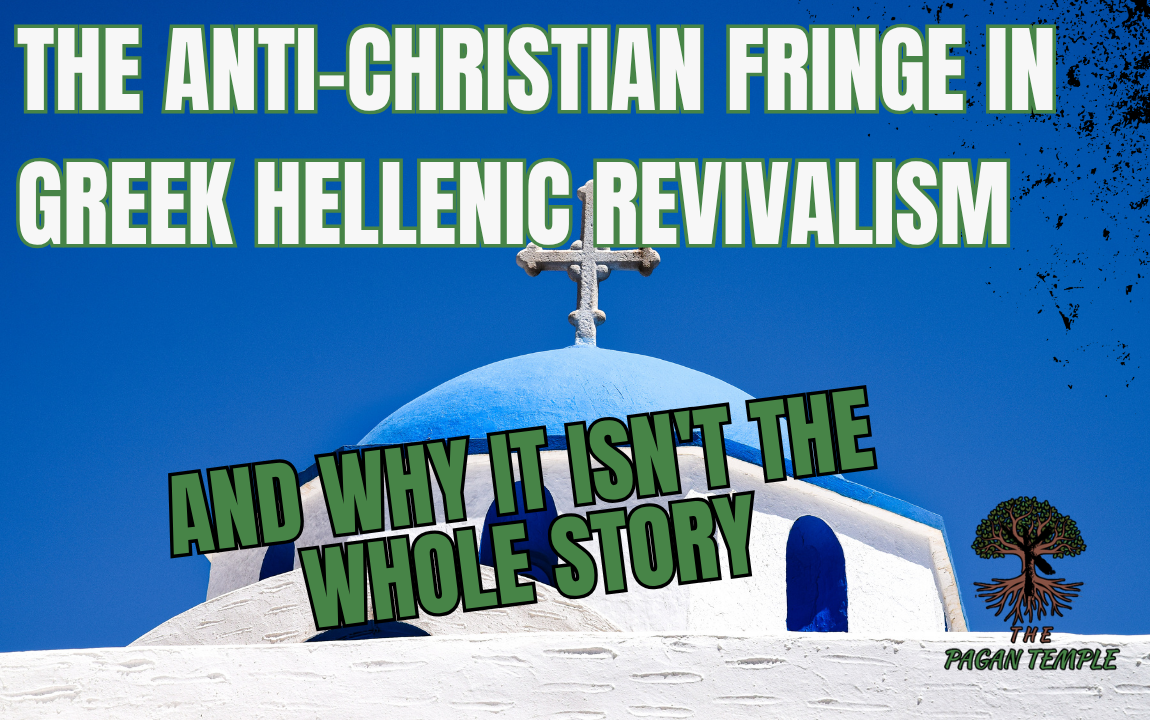
This site does not bury uncomfortable subjects in footnotes, and that standard applies here too. Within Greek Hellenic religious revival specifically, a small but real and historically documented fringe has framed itself in explicitly anti-Christian terms, with at least one organization, a group calling itself the Church of the Hellenes, historically calling for the wholesale extermination of Christianity as part of its rhetoric. That is a real, documented part of this movement's history, and pretending otherwise to keep the tradition looking uniformly tidy would be exactly the kind of dishonesty this site tries to avoid elsewhere.
Getting the Scale Right
At the same time, proportion matters as much as honesty does. This is a genuinely different situation than the well documented, much larger scale white nationalist co-optation problem affecting Norse and Slavic pagan revival specifically. The anti-Christian fringe within Greek Hellenic revivalism is smaller, more narrowly focused on religious and national antagonism toward Christianity specifically rather than the racialized ideology driving Norse and Slavic co-optation, and does not appear to represent anything close to the mainstream of the movement, based on the organizations' own public positioning.
Major Greek Hellenic revival organizations explicitly reject this framing. Ellinais, another prominent Greek Hellenic revival organization, has publicly emphasized world peace and the brotherhood of man as its own framing, a deliberate and explicit contrast to the more antagonistic rhetoric coming from the fringe.
Where This Comes From Historically
Greek Hellenic religious revival emerged partly in a specific cultural and political context: a country where Orthodox Christianity holds an unusually close historical relationship to national identity and, until relatively recently, an officially favored constitutional status. Reviving an explicitly pre-Christian religious identity in that specific context inevitably carries some charge of cultural and religious contrast with Christianity that a similar revival movement in a more religiously pluralistic country might not carry to the same degree. That context helps explain why this particular fringe developed where it did, without excusing or minimizing the extremist rhetoric some individuals within it have used.
Why This Differs From How We Handle Norse Content
Readers familiar with this site's Norse content will notice a mandatory, prominent misappropriation disclaimer addressing white nationalist co-optation in every piece of Norse content, without exception. We are not applying that same blanket, mandatory-everywhere treatment to Hellenic content, and that is a deliberate choice based on genuine differences in scale and character between the two situations, not an inconsistent double standard. The Norse co-optation problem is large scale, well documented, racially motivated, and shows up constantly enough in real-world contexts that every piece of Norse content benefits from addressing it directly. The Hellenic anti-Christian fringe is smaller, more narrowly religiously and nationally motivated rather than racially motivated, and does not require the same blanket treatment across every single piece of content, though it absolutely deserves this dedicated, honest treatment here.
How to Recognize This Rhetoric When You See It
Practically, this kind of fringe rhetoric tends to show up as explicit hostility toward Christianity specifically, rather than the broader, more general religious pluralism that mainstream Hellenic revival organizations typically express, sometimes paired with exclusionary nationalist framing about who legitimately belongs within Greek cultural or religious identity. It tends to present Hellenic religious revival as fundamentally a project of reversing or undoing Christianity's historical dominance specifically, rather than as a positive project of building accessible modern religious practice and education in its own right. If you encounter content, online or otherwise, that centers hostility toward another religion rather than centering Hellenic religious practice and education on its own terms, that is a meaningful signal you have encountered fringe material rather than mainstream Hellenic revival content.
Why Naming This Fringe Does Not Validate Broader Anti-Pagan Prejudice
It is worth adding one more piece of honesty here, in the other direction. Acknowledging this fringe exists should not be used, by anyone hostile to modern paganism generally, as a reason to treat the entire modern Hellenic community, or modern paganism more broadly, as inherently extremist or anti-Christian. Every religious revival or reform movement, across history and across traditions far beyond paganism, has produced some fringe element that does not represent its mainstream. Naming this fringe honestly, as this site does, is a commitment to accuracy, not an invitation to use it as a weapon against the much larger number of serious, historically grounded, pluralistic Hellenic practitioners and organizations who explicitly reject that rhetoric.
What This Means for How You Engage With Greek Hellenic Revival Material
If you encounter explicitly anti-Christian extremist rhetoric within Greek Hellenic revival spaces specifically, recognize it as a real but fringe element, not representative of organizations like Hellenion, YSEE's mainstream public positions, Elaion, or Ellinais, all of which orient their public material around historical and religious revival rather than antagonism toward other religions. The existence of a fringe within any religious revival movement does not delegitimize the movement's mainstream, serious, historically grounded practitioners and organizations.
If you create content yourself, the practical takeaway is straightforward: address this topic honestly when it is relevant, the way this post has, rather than either pretending it does not exist or treating it as so central that it overshadows the much larger mainstream community's actual work. Proportionate, honest treatment of uncomfortable topics, applied consistently across every tradition this site covers, is the same standard this site holds itself to with Norse content, with Spartan source problems, and with every other difficult subject addressed throughout this content suite. Hellenismos is not exceptional in having an uncomfortable corner. It is simply being treated with the same direct honesty as everything else here.
For the broader honest treatment of sensitive issues this site commits to across all content, see Hellenic Polytheism pillar page.