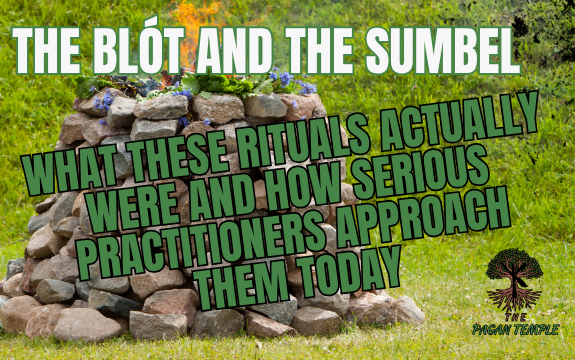

Two ritual forms sit at the center of historical and modern Heathen practice. The blot is a sacrificial offering, a way of giving something of value to the gods and spirits in exchange for relationship and favor. The sumbel is a drinking ceremony, a formalized sequence of toasts in which words spoken carry binding weight. They are different in form and function, and both are more interesting than their reputation in popular culture suggests.
This post covers what the historical sources actually say about both rituals, what the archaeological evidence supports, and what modern practitioners do with them.
The Blot: What It Was
The Old Norse word blot is related to a verb meaning, roughly, to strengthen with blood or to consecrate through sacrifice. The ritual involved offering something of value, typically animals but also food and drink, to divine powers in the context of a communal gathering. The offering was followed by a sacred feast at which the offered animals or food were consumed by the community. The act of sacrifice and the act of communal eating were not separate events. They were two parts of the same ritual transaction.
Adam of Bremen, writing in the 1070s CE about the temple at Uppsala in Sweden, describes a major blot held every nine years in which nine of every living creature were sacrificed. This is an outsider account written by a Christian with an explicit anti-pagan agenda, and the more spectacular details deserve skepticism. But the broad picture he paints, a large communal sacrifice followed by feasting, with the sacred site as the focal point, is consistent with what other sources describe and with archaeological evidence from the region.
The household blot was smaller in scale but probably more common. Saga accounts describe family heads conducting seasonal blots, with offerings made to deities associated with specific domains: Thor for weather and protection, Freyr for fertility and harvest, Odin for victory or special petition. The relationship between the household and the divine powers was an ongoing one, maintained through regular exchange.
What the blot was not: a solemn, silent ceremony performed by priests at a distance from the community. The surviving accounts describe it as participatory, communal, and followed by eating, drinking, and sociability. The sacred and the social were not separated.
The Archaeological Evidence for Sacrificial Practice
The textual accounts of blot are supported by material evidence from across Scandinavia. Votive deposits in lakes and bogs, objects of value deliberately placed in bodies of water as offerings, are documented across the Norse world and the broader Germanic region. These include weapons, tools, jewelry, and in some cases human remains. The Iron Age bog bodies found across Northern Europe, Tollund Man in Denmark being the most famous example, show evidence of ritual killing, though scholarly debate continues about whether these were sacrificial victims or executed criminals, or both.
At temple sites like Gamla Uppsala in Sweden, archaeological excavations have recovered animal bones in patterns consistent with large-scale ritual feasting. Post-holes suggest the existence of substantial wooden structures that have not survived. The physical evidence confirms that communal sacrifice and feasting took place on a significant scale at major religious sites, even if it cannot confirm the specific details that the textual sources describe.
Modern Blot Practice
Modern Heathen blot does not typically involve animal sacrifice, though this varies by community and practitioner. Most modern blots center on an offering of mead, ale, or another drink, often combined with food. The offering is made to specific divine beings, the purpose of the blot is stated, and a portion of the offering is poured out or otherwise given over as the gift to the powers being addressed. The remainder is shared by the participants in a communal drink.
The Troth and most inclusive Heathen organizations have documented blot liturgy available. Individual kindreds develop their own forms. What varies most across communities is the degree of formal structure, and the specific deities addressed, which typically correspond to the seasonal observance or the particular need of the community at that time.
The Sumbel: What It Was
The sumbel, or symbel in Old English, is a ritual drinking ceremony documented in both Old Norse and Old English sources. In its basic form, a drinking vessel is passed around a group of participants, and each person speaks in turn, making a toast, a boast, or a vow. The toasts are typically organized in rounds: the first round honoring specific gods, the second honoring ancestors and heroes, the third for personal boasts or vows.
What makes the sumbel distinctive and important is the weight it assigns to spoken words. In the world described by the Norse and Old English sources, words spoken at sumbel were not casual. They were witnessed by the gods and ancestors, and a vow made at sumbel was binding in a way that an ordinary promise was not. The Havamal makes this explicit: the cost of broken words is high. The sumbel was the ritual context that made speech consequential in a formal, sacred sense.
The Old English poem Beowulf contains one of the most detailed accounts of what a formal hall ceremony looked like in practice, though its religious dimensions are partially obscured by the poem’s Christian overlay. The communal hall, the passage of the drinking cup, the boasts of warriors, and the songs of the scop all reflect a ritual social world in which speech and action were bound together in ways that had religious as well as social weight.
Modern Sumbel Practice
The modern sumbel follows the historical pattern closely. A horn or cup is passed around the group. The first round is typically given to the gods, with each participant raising the horn and speaking to whatever divine beings they wish to honor. The second round honors ancestors, heroes, and those who have gone before. The third round is open for boasts, personal commitments, or remembrances.
The key principle that most modern Heathen communities enforce: do not vow at sumbel what you cannot or will not actually do. The sumbel is not a space for empty words. Vows made there are taken seriously by the community, and communities that take the sumbel seriously will hold each other accountable for what was said.
This is, in some ways, the most distinctively Heathen of the two rituals, because it has no close parallel in most other modern pagan traditions. The combination of communal witnessing, divine witnessing, and binding speech is specific to the Germanic tradition. It is worth engaging with carefully and honestly.
The Relationship Between the Two Rituals
Blot and sumbel often occur together in modern Heathen practice, and this is historically supported. A communal gathering that involves offering, feasting, and formal speech in which commitments are made and relationships strengthened is a coherent whole, not two separate things stuck together.
Both rituals work on the same basic principle: relationship with divine powers and with each other is maintained through reciprocal exchange. You give to the gods. You give your word to the community. Both acts have weight. Both acts create obligation. That is not a burden in this tradition. It is the point.