
The Norse people buried their religion in the ground. Not figuratively. Literally. They buried it with their dead, deposited it in lakes and bogs, carved it into stone, and pressed it into metal. The textual sources for Norse religion were written by Christians. The archaeological evidence was created by the practitioners themselves. When you want to know how the Norse actually worshipped, the dirt sometimes tells you more than Snorri does.
This post covers the major categories of archaeological evidence for Norse and Germanic religious practice: ship burials, bog deposits, runestones, and what each type of evidence can and cannot tell us.
Ship Burials: What They Are
Ship burial is the practice of interring the dead within a ship, either as a cremation on the water or as an inhumation in a ship that is then buried under a mound. It was practiced across Scandinavia during the Viking Age and the earlier Vendel period (roughly 550-790 CE), and it represents one of the most expensive and elaborate funerary practices in the Norse world. Not everyone got a ship burial. The practice was reserved for individuals of exceptional status: rulers, wealthy merchants, and what the archaeology increasingly suggests were ritual specialists.
The ships themselves were real, functional vessels capable of oceanic travel. Burying one with a dead person was a significant act of material expenditure. The grave goods placed in and around the ship were often of extraordinary quality and reach. Oseberg, Gokstad, and Tune in Norway, and the Vendel period graves in Sweden, represent the richest surviving examples.
The Oseberg Burial in Detail
Excavated in 1904 near Tonsberg in Norway, the Oseberg ship burial is the most lavishly equipped Viking Age burial ever found. The ship, an oak vessel approximately 22 meters long, was buried under a mound around 834 CE and contained two women. One was between 70 and 80 years old; the other was between 50 and 55. They are typically called the Oseberg women, and their specific identities remain debated.
The grave goods are extraordinary in both quality and quantity: ornately carved wooden posts, a wagon, sledges, beds, textiles including tapestries depicting ritual scenes, domestic equipment, animals (horses were sacrificed as part of the funeral), and personal items. Among the personal items of the older woman were a carved wooden staff, a small pouch containing cannabis seeds, and a wooden container with henbane seeds, the latter two being known psychoactive substances consistent with the material assemblage of the volva burials Neil Price has documented.
The interpretation that the older woman was a ritual specialist is based on this material assemblage fitting a consistent pattern across multiple high-status female burials at different sites. The wooden staff, the psychoactive plant material, the high-status burial context, and specific categories of unusual exotic goods all appear together in approximately 40 sites across Scandinavia, which Price argues is strong evidence that the volva was a recognized and well-compensated social role.
Gokstad and What It Tells Us
The Gokstad ship burial, excavated in 1880, contained a single man of about 40 to 50 years old, with evidence of serious physical injury that may indicate he died in battle or combat. The ship is preserved well enough that it was replicated and sailed across the Atlantic in 1893. The grave goods at Gokstad include peacocks and other exotic birds, which again points to elite access to international trade networks.
What Gokstad adds to the picture of Norse funerary practice is evidence for the scale and quality of Viking Age shipbuilding and for the centrality of the ship as a cultural symbol. The ship does not appear in Viking Age funerary practice randomly. It represents, in the cosmological framework of this tradition, a vessel capable of traversing the boundary between worlds, carrying the dead across the waters to wherever they are going.
Bog Deposits and Votive Practice
Across Northern Europe, from Scandinavia through Germany and the British Isles, the Iron Age and early medieval archaeological record contains thousands of deliberately deposited objects in bogs, lakes, rivers, and other bodies of water. These deposits are not accidental. The objects are often of high value, they are sometimes deliberately destroyed (bent, broken, or decommissioned) before deposition, and they appear at the same sites repeatedly over centuries, suggesting that specific locations were understood as sacred and the deposits as ongoing offerings.
The most famous bog finds are not objects but people: Tollund Man in Denmark, Lindow Man in Britain, Grauballe Man in Denmark, and dozens of others. These individuals, preserved by the tanning qualities of peat, were killed before being deposited in the bog, often in ways that suggest ritual rather than simple execution. Scholars debate how many of these were religious sacrifices versus executed criminals, but the deliberateness of the depositions is not in question.
For the more common category of object deposits, weapons, jewelry, coins, and animal remains are the most frequent finds. The consistent pattern of deposition at specific watery sites over extended periods is the clearest evidence we have for the practice of votive offering described in the textual sources. You give something of value to the waters. The waters receive it. The relationship is maintained.
Runestones: What They Say and What They Don’t
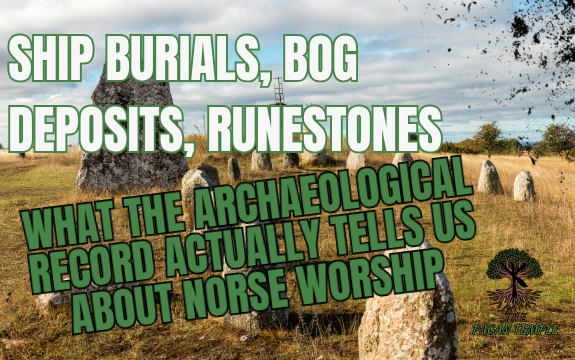
Runestones are carved upright stones bearing runic inscriptions, raised predominantly in Scandinavia during the Viking Age, with the greatest concentration in Sweden. There are approximately 2,500 known runestones in Sweden alone, with additional examples in Denmark, Norway, and the areas of Viking diaspora. They were raised primarily as memorials to the dead, typically commissioned by family members and recording the name of the deceased, the name of the person who commissioned the stone, and a brief description of the deceased’s character or achievements.
Many runestones include formulaic phrases with religious content. Some invoke Thor’s protection: May Thor hallow these runes. Some describe the deceased’s travel or death. The Gotland picture stones are famous for their depictions of ships, Valkyries, the hall of the dead, and what appear to be scenes from mythology. The Rok runestone in Sweden contains one of the longest runic inscriptions ever found and remains only partially interpreted, including what appears to be mythological content.
What runestones cannot tell us: the specific content of religious belief beyond the brief formulaic phrases they contain. They are memorials, not theological documents. They tell us that invoking Thor’s protection at the moment of death was common enough to be formulaic, which is itself significant evidence. They do not tell us what that invocation meant theologically in any detail.
What the Material Evidence Cannot Tell Us
The archaeological record has a fundamental limitation: objects do not explain themselves. The Oseberg grave goods tell us that two women of extraordinary status were buried with a ship and specific equipment. They do not tell us exactly what rituals accompanied the burial, what prayers were spoken, what beliefs motivated the specific choices of grave goods. We can infer, we can compare with textual sources, we can find patterns across multiple sites. But the inference is always interpretation, and interpretation can be wrong.
The most responsible approach is to use the material evidence and the textual evidence together, each checking and complicating the other. Where they agree, we can have more confidence. Where they diverge or where one is silent while the other speaks, we need to be careful about how much certainty we claim.