
Why This Is Genuinely Harder Than It Looks
The ancient Athenian religious calendar was lunar, civic, and deeply tied to a city-state infrastructure that simply does not exist anymore. Festivals were timed to specific lunar months that do not align cleanly with the Gregorian calendar most of us actually live by, and many of them involved large scale civic participation through institutions, temples, and public processions that a modern solitary practitioner has no access to.
This means anyone telling you there is one single, universally correct modern date for a given festival is overstating their certainty. Different reconstructionist organizations, including Hellenion, Elaion, and others, maintain their own working calendars, and these calendars sometimes differ. That is not a flaw in the modern community. It is an honest reflection of a genuinely difficult reconstruction problem.
The Major Festivals Worth Anchoring Your Calendar Around
A few festivals are well enough documented, in terms of general timing and basic function, to serve as solid anchors even before you sort out every calendrical detail.
The Panathenaia, honoring Athena, fell in late summer in the ancient Athenian calendar and involved procession, athletic and musical competition, and the presentation of a new robe for Athena's cult statue. A modern adaptation might involve a personal renewal of your relationship with Athena, some form of creative or physical achievement marking the occasion, and a small act of dedication or rededication at your household shrine.
The Anthesteria, a spring festival connected to new wine and carrying a notably underworld-tinged character, offers a useful seasonal anchor point connecting Dionysos to themes of both celebration and the presence of the dead. A modern version might involve marking the first taste of something new in the season alongside a small acknowledgment of ancestors or the dead.
The Thargelia, tied to Apollon and agricultural purification, falls in late spring and connects to themes of cleansing and renewal ahead of the harvest season. A modern adaptation might involve a seasonal cleaning ritual for your household shrine or living space, paired with prayer to Apollon.
The Eleusinia, connected to Demeter and Persephone and distinct from the more famous, secretive Eleusinian Mysteries held at the same sanctuary, involved athletic competition and public celebration tied to the agricultural cycle and fell in late summer. A modern household adaptation might focus on the Demeter and Persephone myth's themes of loss, return, and the cycle of growth, without attempting to recreate the initiatory Mysteries themselves, which remain a separate and much more restricted topic.
A Practical Method for Building Your Own Working Calendar
Start by choosing two or three major festivals that connect to deities you already have an active relationship with, rather than trying to track the entire ancient Athenian calendar at once. Trying to observe everything immediately is a common way beginners burn out on festival practice within the first few months.
Next, decide whether you are anchoring observance to the actual ancient lunar timing, which requires tracking specific moon phases, or simplifying to a fixed Gregorian date each year for consistency and ease of planning. Both approaches exist within the modern community, and neither one is more "correct" in any settled sense. Hellenion's published calendar is a useful reference point if you want to see how one established organization handles this question.
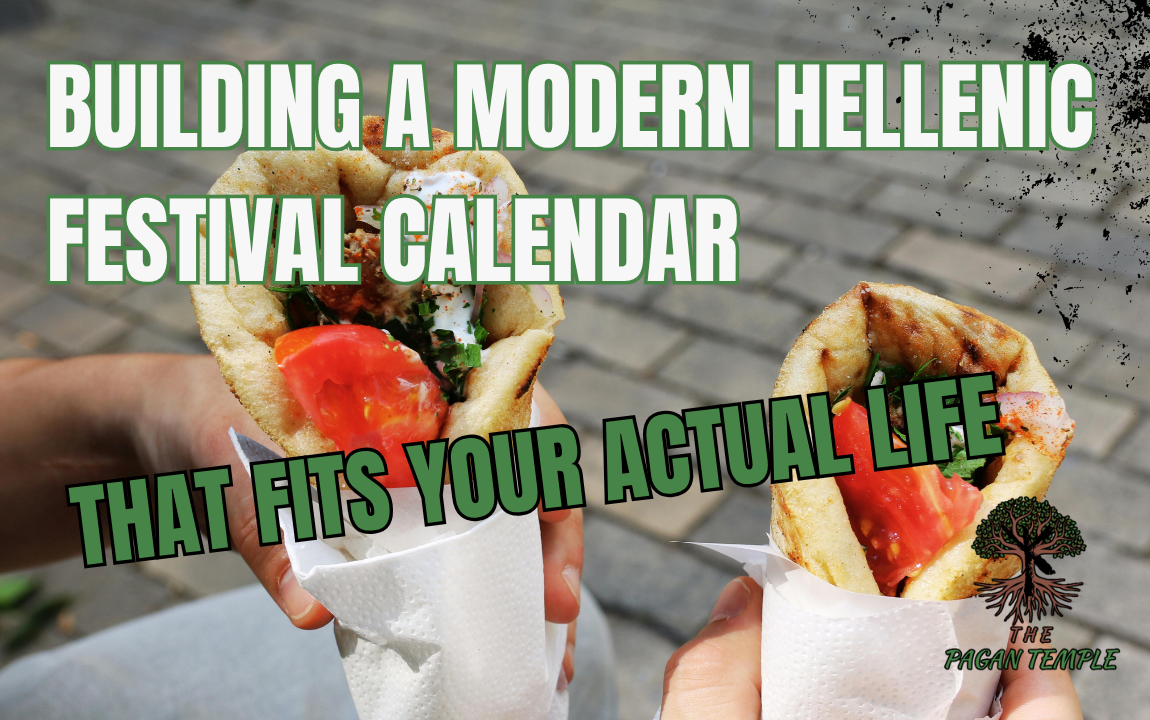
Finally, build in flexibility from the start. Modern life includes work schedules, family obligations, and circumstances ancient civic religion never had to account for at an individual level. A festival observance scaled down to fit a busy Tuesday evening is still a legitimate observance. The goal is sustained practice, not theatrical recreation.
Smaller Observances Worth Considering Alongside the Major Festivals
Beyond the three major festivals already discussed, the ancient Athenian calendar included a number of smaller, more frequent religious observances tied to the lunar month itself, rather than to a single annual festival. The new moon (noumenia) was traditionally associated with Hekate and a fresh start to the month, while specific days within each lunar month carried their own particular associations and were considered more or less favorable for honoring specific deities.
Modern practitioners interested in a more frequent, lower-key rhythm beyond the major annual festivals sometimes adopt a monthly noumenia observance as a regular practice, marking the start of each lunar month with a small dedicated act of devotion. This gives you a more frequent touchpoint for practice than relying solely on a handful of major annual festivals spread out across the entire year, without requiring you to track the full complexity of the ancient civic calendar in detail.
Handling Calendar Disagreements Across Sources Gracefully
If you spend time researching this topic across multiple sources, you will run into genuine disagreement about specific modern dates, sometimes from sources that otherwise seem equally credible and well researched. This is not a sign that one source is simply wrong and another is correct. It is an honest reflection of the underlying reconstruction challenge: converting a lunar civic calendar from a specific ancient city into a usable modern framework involves real interpretive choices that different careful, well-intentioned reconstructionists have made differently.
A practical approach, rather than trying to determine the single "correct" date, is choosing one source or organization's calendar, understanding the general reasoning behind their choices, and using it consistently for your own practice, while remaining open to the fact that other practitioners using a different source's calendar are not doing anything wrong either.
Connecting Festival Practice to the Wider Seasonal Year
Even where exact ancient dating remains uncertain, the general seasonal logic behind these festivals, harvest themes in late summer, wine and underworld themes in spring, purification ahead of the growing season, holds up well as an organizing structure regardless of exactly which calendar date you land on. Building your personal festival practice around this broader seasonal logic, rather than insisting on pinpoint historical accuracy down to the exact day, is a reasonable and honest way to engage with festival practice while being upfront about the genuine limits of calendrical reconstruction.
What to Avoid
A few habits tend to derail people who are otherwise doing fine with this. The first is treating a missed festival as a practice failure. Life happens. A noumenia you forgot to mark or a Panathenaia you let slide because of a work deadline is not evidence that you are bad at this or that the gods are keeping score. Consistent practice over years matters more than a perfect unbroken streak, and a calendar that punishes you emotionally for being human is not a calendar worth keeping.
The second is adopting a calendar wholesale from a blog or social media post without understanding why it lands on the dates it does. Some of what circulates online is carefully reasoned, cross-referenced against epigraphic and literary evidence, and clearly labeled as an interpretation. Some of it is a guess copied from another guess with the uncertainty stripped out along the way. Before you commit to a source's calendar, look for whether they explain their reasoning. If they do not, treat their dates as a starting point rather than a settled answer.
The third is importing the Wiccan Wheel of the Year wholesale and treating it as though it maps onto Hellenic practice. The Wheel of the Year is a Wicca-specific framework built around eight evenly spaced solar points, and it developed independently of ancient Greek civic religion. Some modern eclectic practitioners do blend the two, and that is their call to make, but presenting the Wheel of the Year as a universal pagan calendar that Hellenic festivals simply slot into misrepresents both traditions. The Athenian festival calendar has its own internal logic, tied to lunar months and specific civic functions, and it deserves to be understood on those terms rather than flattened into a framework it never belonged to.
Where to Start This Week
Pick one festival connected to a god you already work with, mark a date for it on your actual calendar, even an approximate or simplified one, and plan one small, doable observance. That is a real working start, and it can grow in complexity from there as you get more comfortable.