
Odin gouged out his own eye and threw it into a well. Then he hung himself on a tree for nine days with a spear wound in his side. He did both of these things voluntarily, in exchange for knowledge. That tells you everything that matters about who this god is and what your relationship with him will cost.
The mythology about Odin is consistent on one point across every source: he seeks knowledge, and he pays for it. Not metaphorically. Not symbolically. He gives up real things, including parts of himself, because the knowledge is worth more than the cost. That is the central bargain at the heart of this deity’s mythology, and practitioners who work with him should understand it clearly before they begin.
The Eye at Mimir’s Well
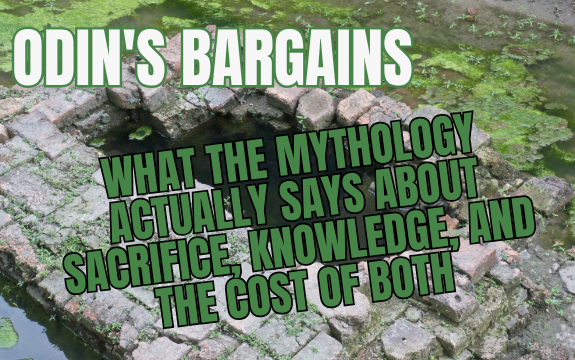
The Voluspa and the Prose Edda both describe Odin sacrificing one of his eyes at the Well of Mimir in exchange for a drink from the well’s waters. Mimir’s Well sits beneath one of the three roots of Yggdrasil and is the source of cosmic wisdom. Mimir himself is a being of ancient knowledge, associated with the primordial period before the current order of the gods was established.
The exchange is straightforward in the sources: Odin wants what the well contains. Mimir names the price. Odin pays it. There is no negotiation, no attempt to get the wisdom without cost. The mythology presents this as the correct way to obtain genuine knowledge: you name what you want, you pay what it costs, and you do not try to cheat the transaction.
One-eyed Odin is, in this reading, not diminished by his sacrifice. He is defined by it. The missing eye is visible evidence of what wisdom actually cost him. It is not a wound to be healed. It is a mark of what he chose and what he became because of that choice.
The Runes and the Gallows
The Havamal, the wisdom poem attributed to Odin and preserved in the Poetic Edda, contains one of the most striking passages in the entire corpus. Odin speaks in his own voice: I know that I hung on the windswept tree for nine full nights, wounded with a spear, and given to Odin, myself to myself, on that tree which no man knows from what roots it rises.
He hangs on Yggdrasil, wounded, for nine nights, without food or water. At the end of the nine nights, he sees the runes, takes them up, and falls from the tree. The runes are not given to him. He discovers them through the ordeal. The specific grammatical phrasing, given to Odin, myself to myself, makes clear that this is a self-sacrifice of an unusual kind: he gives himself as an offering to himself in order to gain something that cannot be obtained any other way.
What the runes represent in this context is a system of cosmic knowledge, the patterns underlying reality. The Havamal then goes on to list eighteen runic charms and their uses. The ordeal is not an end in itself. It is the price of a specific kind of understanding, the kind that requires entering the pattern directly rather than studying it from outside.
The Ravens and the Dead
Odin’s two ravens, Huginn and Muninn, Thought and Memory, fly out every day across all the worlds and return to whisper what they have seen into his ears. This is not decoration. It is a description of an ongoing intelligence operation: Odin is constantly gathering information about what is happening across the cosmos, because he needs to know.
He needs to know because Ragnarok is coming, and he has been preparing for it since before the current age began. Valhalla, the hall of the slain, exists because Odin needs an army. The einherjar, the warriors gathered there, are being trained for the final battle. Odin’s relationship with the dead, his role as the god who receives the honored slain, is not primarily about honoring those warriors. It is about his preparation for the end of the world.
The Voluspa is explicit: Odin knows what is coming. He knows he will be swallowed by Fenrir at Ragnarok. He is not trying to prevent it. He is trying to be ready for it, to fight it as well as it can be fought, even knowing the outcome. The knowledge he seeks is the knowledge of how to act well in the face of what cannot be changed. That is a different relationship to fate than most modern readers bring to the mythology.
What This Means for Practice
Practitioners who work with Odin are working with a deity whose entire mythology is organized around the principle that genuine knowledge has genuine cost, that what you want will be asked for at the price of something you value, and that the correct response to that demand is neither to refuse nor to try to circumvent it but to pay honestly.
This is not a comfortable patron deity for people who want to be inspired without being challenged, or who want wisdom without the discipline of actually pursuing it. The mythology is consistent: Odin does not give things freely. He exchanges. And the things he has given up in exchange for what he knows, the eye, the nine days on the tree, his own willingness to be a sacrifice to himself, are a model of what that kind of exchange looks like.
A relationship with Odin in modern practice tends, in the accounts of serious practitioners, to involve exactly this structure. He asks things. The asking is not punitive. It is the mechanism of the relationship. You give something. You receive something. Both parties are changed by the exchange. If that dynamic does not appeal to you, there are other figures in this pantheon who ask less and demand less of their devotees. Odin is a specific kind of relationship, and it is worth understanding that specificity before you begin.
The Patron of What?
Odin is often described as the god of wisdom, war, death, and poetry. All of these are accurate in the sense that the mythology associates him with all of them. But the common thread is not a list of domains. It is the drive to know what cannot be easily known, and the willingness to pay what that knowing costs. His wisdom is not comfortable or safe. His association with death is because the dead know things the living do not. His poetry is the kind that comes from having seen clearly into the nature of things.
This is a god for people willing to look directly at difficult truths and pay the cost of that clarity. That is not a rare human motivation. But it is a specific one, and it is worth being honest about whether it describes you before you make him your primary point of devotion.