
Start Here
Have you ever tried to read Norse mythology and found yourself lost? The gods are fighting giants, a squirrel is running up a tree, someone gives up an eye for wisdom, and it is not entirely clear what any of it has to do with anything else.
Most of the time, what is missing is the map.
Norse mythology takes place inside a specific cosmic structure. Once you understand that structure, all the individual stories start to make sense. You know where the characters are, why they travel where they travel, and what is at stake.
This lesson is that map. By the end, you will understand the Norse cosmos clearly enough to make sense of everything else in the tradition.
What You Will Learn
- What Yggdrasil is and why the World Tree matters
- All nine worlds: who lives there and why each one exists
- The three wells and the beings who tend them
- How this cosmology shows up in Norse pagan practice
- The most common misconceptions about the Norse cosmos, corrected
[EMBEDDED YOUTUBE VIDEO]Table of Contents
- Section 1: The Basics of Norse Cosmology
- Section 2: Yggdrasil, the World Tree
- Section 3: The Nine Worlds
- Section 4: The Three Wells
- Section 5: How This Shows Up in Practice
- Section 6: Common Misconceptions
- Section 7: Putting This Into Practice
Section 1: The Basics of Norse Cosmology
Cosmology is the word scholars use for the story a culture tells about the structure of existence. It answers questions like: Where did the world come from? What exists beyond what humans can see? What happens when we die?
In Norse tradition, these questions are answered through a living, interconnected framework. The Norse cosmos is not empty space. It is a structured reality with specific realms, beings, and forces, all connected to one another.
Key term:"Cosmology" (koz-MOL-oh-jee) means a culture's understanding of how the universe is structured and where everything fits within it.
Where These Ideas Come From
Our primary sources for Norse cosmology are two medieval Icelandic texts. The first is the Prose Edda, written by a scholar named Snorri Sturluson around 1220 CE. The second is the Poetic Edda, a collection of older poems gathered around the same period by unknown authors.
These texts were written after Iceland had already converted to Christianity. That timing matters because Snorri was a Christian scholar recording older Norse beliefs. He did his best to preserve them accurately, but his own framework occasionally shapes how he presents the material.
Modern Norse practitioners and scholars work with both texts carefully, drawing on the older poetry in the Poetic Edda alongside Snorri's summaries in the Prose Edda.
| Important Note |
| Norse cosmology as we understand it comes primarily from medieval Icelandic sources. What was practiced before those texts were written, and how closely the written accounts reflect actual pre-Christian belief, is something scholars are still working through. That uncertainty is part of honest engagement with the tradition. |
Section 2: Yggdrasil, the World Tree
At the center of the Norse cosmos stands Yggdrasil, the World Tree.
Yggdrasil is described in the Eddas as a massive ash tree. Its branches spread above the sky. Its three roots reach down into three different wells, each connected to a different aspect of existence. Nine worlds are held within and around it.
Key term:Yggdrasil (IG-dra-sil) means "Odin's horse" or "Odin's gallows" in Old Norse. The name refers to a myth where Odin hung himself from the tree to gain wisdom. The tree itself is the structural center of the Norse cosmos.
What Lives in the Tree
The tree is not empty. An eagle perches in its upper branches. A dragon named Nidhogg gnaws at one of its roots from below. A squirrel named Ratatoskr runs up and down the trunk carrying messages between the eagle above and the dragon below, and those messages are mostly insults.
Four stags named Dain, Dvalin, Duneyr, and Durathror wander the branches eating the buds and leaves.
Every day, the three Norns, the beings who weave fate, draw water from the Well of Urd beneath one of the roots and pour it over the tree to preserve it. Without that care, even Yggdrasil would decay.
How to Think About the Nine Worlds Within the Tree
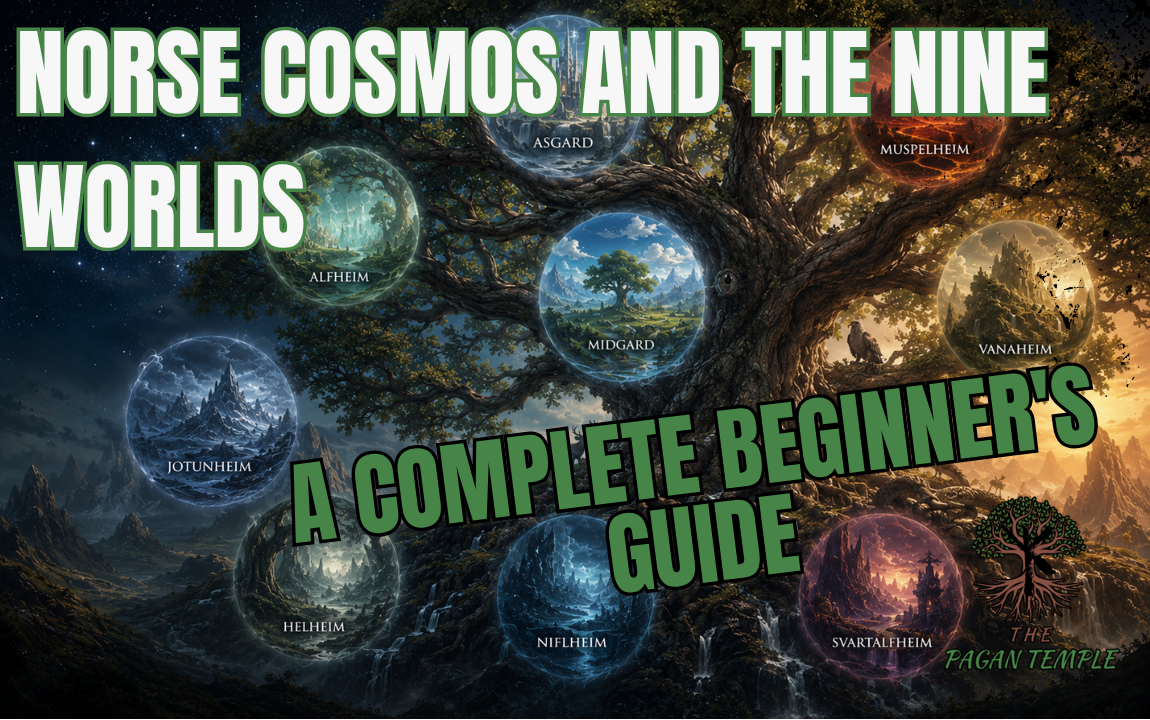
You will often see diagrams showing the nine worlds arranged in a vertical stack, Asgard at the top, Midgard in the middle, Niflheim at the bottom. These diagrams are useful starting points.
They are not literal descriptions from the texts. The Eddas do not give us a diagram. Different passages describe the worlds in ways that scholars still interpret differently. Use those images as helpful guides while knowing the actual relationship between the worlds is more complex.
Section 3: The Nine Worlds
The nine worlds are consistently mentioned across multiple sources, though not every source lists all nine by name in the same place. Here is a complete account of each world based on what the sources tell us.
1. Asgard: Home of the Aesir Gods
Name means:"Enclosure of the Aesir."
The Aesir are one of the two families of Norse gods. Major Aesir deities include Odin, Thor, Frigg, Tyr, Baldr, and Loki in his earlier associations.
Asgard is a realm of halls and palaces. The most famous of these is Valhalla, where Odin receives half of those who die in battle. The Bifrost bridge connects Asgard to Midgard and the other worlds.
2. Vanaheim: Home of the Vanir Gods
Name means:"Home of the Vanir."
The Vanir are the second family of Norse gods, associated with fertility, nature, and agricultural cycles. Key Vanir deities include Njord, the sea god, and his children Freyr and Freyja.
After a war between the Aesir and Vanir, a peace treaty was made and hostages were exchanged. That is why Freyr and Freyja live in Asgard in the mythology rather than Vanaheim.
3. Alfheim: Home of the Light Elves
Name means:"Elf home."
The light elves are described in the sources as beings more radiant than the sun. Freyr was said to receive Alfheim as a gift, which suggests a close connection between the Vanir gods and the elves.
Elves in Norse tradition are not the small folk of later European fairy tales. They are powerful, luminous beings with their own agency and significance within the cosmos.
4. Midgard: The World of Humans
Name means:"Middle enclosure" or "middle realm."
Midgard is where we live. According to the Prose Edda, it was created from the body of a primordial being named Ymir. Odin and his brothers shaped Ymir's flesh into the earth, his blood into the seas, his bones into mountains.
The first humans, Ask (ash tree) and Embla (elm tree), were fashioned from two trees and given the gifts of breath, warmth, and consciousness.
Midgard is surrounded by a great ocean where the World Serpent Jormungandr lies coiled. Jormungandr is large enough to encircle the entire world and bite its own tail.
5. Jotunheim: Home of the Jotnar
Name means:"Home of the Jotnar."
Key term:Jotnar (YOT-nar) is the plural of Jotunn. They are often translated as giants, but they are not simply large humans. They are ancient, primordial beings who predate the gods, embody natural forces, and exist in a complicated relationship with Asgard.
The jotnar are not simply villains. Odin's mother was a jotun. Thor's mother was a jotun. The gods routinely marry jotnar. The conflict between Asgard and Jotunheim is not a moral conflict between good and evil. It is a cosmic tension between different kinds of power.
Jotunheim is described as a wild, difficult realm. The city of Utgard, home to a powerful being named Utgard-Loki, is located there.
6. Niflheim: The World of Ice and Mist
Name means:"Mist world" or "mist home."
Niflheim is one of the two primordial realms, the original cosmic forces before creation. It is the realm of ice, cold, and mist in the north.
According to the creation account in the Prose Edda, the space between Niflheim and Muspelheim was called Ginnungagap, the yawning void. When the cold from Niflheim met the fire from Muspelheim in the void, the first being, Ymir, emerged from the melting ice.
The spring called Hvergelmir is located in Niflheim. From it flow eleven rivers called the Elivagar, the ancient rivers at the beginning of existence.
7. Muspelheim: The World of Fire
Name means:Related to destruction and fire. The exact etymology is debated.
Muspelheim is the primordial realm of fire in the south. Like Niflheim, it existed before the other worlds were made. A being called Surtr rules it, described as wielding a great flaming sword.
Muspelheim's role is most prominent at the end of the cosmic cycle. In the prophecy of Ragnarok, Surtr leads the forces of Muspelheim out to battle, and his fire ultimately covers the earth.
8. Svartalfheim: Home of the Dark Elves and Dwarves
Name means:"Dark elf home."
Svartalfheim is the realm beneath the earth. The dwarves, who are extraordinary craftspeople, are associated with this realm. The relationship between dark elves and dwarves in the source texts is one of the more debated points in Norse scholarship. Snorri treats them as related or overlapping in some passages.
The dwarves made some of the most important objects in Norse mythology. Mjolnir, Thor's hammer. Gungnir, Odin's spear. Draupnir, the self-replicating golden ring. Skidbladnir, the ship that could be folded and carried in a pocket. When the gods needed something extraordinary, they came here.
9. Helheim: The Realm of the Dead
Name means:"Home of Hel."
Key term:Hel is both the name of the realm and the name of its ruler. Hel is the daughter of Loki and the jotun Angrboda. She is described as having a dual appearance, one half living and one half dead. She rules her domain with authority.
Helheim is where most people go after death. It is not a place of punishment. The Norse afterlife does not organize the dead by moral judgment in the way some other traditions describe. Dying a "straw death," meaning dying in bed rather than in battle, was not considered shameful, and those people simply went to Helheim.
The Prose Edda does mention a place called Nastrond within Helheim where those who committed murder, oath-breaking, and adultery are sent. But this is described as a specific location within Helheim, not as the nature of Helheim itself.
| Common Misconception |
| The English word "hell" comes from "Hel," but the concepts are entirely different. Helheim in Norse tradition is not a Christian-style place of eternal punishment. It is the realm of the honored dead who died outside of battle. |
Section 4: The Three Wells
The three roots of Yggdrasil each reach down to a different well. Each well represents a different dimension of the Norse cosmos.
The Well of Urd: Fate
Pronunciation:Urdarbrunnr (OOR-dar-brun-r)
The Well of Urd sits beneath the root that reaches toward Asgard. Three beings called the Norns live here and work beside it.
Key term:The Norns are three beings who shape fate. Their names are Urd ("what was"), Verdandi ("what is becoming"), and Skuld ("what shall be" or "debt"). They weave the fates of gods and humans alike.
Each day, the Norns draw water from the well and use it to water Yggdrasil. They carve runes into the bark of the tree, encoding fate into its structure. This is the source of the Norse concept of wyrd, the interconnected web of cause and consequence that shapes all existence.
Mimir's Well: Wisdom
Pronunciation:Mimisbrunnr (MEE-mis-brun-r)
Mimir's Well sits beneath the root that reaches toward Jotunheim. It is guarded by Mimir, described variously as a god or a wise giant.
The most famous story connected to this well is Odin's sacrifice. Odin came to the well and asked to drink from it. Mimir agreed on one condition: Odin must give up one of his eyes. Odin agreed, placed his eye in the well, and drank. He gained wisdom that could not be gained any other way.
This story captures something central to Norse values. Wisdom has a cost. Knowledge is not given freely. The pursuit of understanding requires real sacrifice.
Hvergelmir: The Source
Pronunciation:Hvergelmir (HVER-gel-meer)
Hvergelmir is the ancient spring in Niflheim, under the root that reaches into the primordial realm of cold. It is the source of the Elivagar, the eleven rivers at the beginning of creation.
The dragon Nidhogg gnaws at this root. Many scholars interpret this as a representation of entropy, the slow force of dissolution that works against the ordered structure of the cosmos. The tree endures despite it, but only because the Norns tend it at the other root.
Section 5: How This Shows Up in Practice
Understanding the Norse cosmos matters for three practical reasons.
First, it makes the mythology legible. The stories in the Eddas happen inside this framework. Knowing which realm a character travels to, who they are likely to meet there, and what the dangers are changes how you understand each story.
Second, some modern Norse practitioners engage in spirit work or forms of meditation and journeying that use the Nine Worlds as a navigational map. The worlds are not just historical background. For some practitioners, they are working realities.
Third, Norse cosmology reflects the values that run through the tradition: sacrifice for wisdom, the inevitability of fate, the cycle of creation and destruction, the importance of one's actions and their consequences. Understanding the structure helps you understand the values.
Section 6: Common Misconceptions
- The nine worlds are not arranged in a neat vertical stack. Online diagrams are useful interpretations, not literal descriptions from the texts.
- Helheim is not a place of punishment. It is simply where most people go when they die.
- The jotnar are not evil. They are primordial forces, sometimes in conflict with the gods, sometimes allied, sometimes their parents.
- The Norse cosmos is not the same as Viking culture. The cosmology spans a long period of Norse culture, not just the Viking Age.
Section 7: Putting This Into Practice
Here is how to actually begin working with what you have learned.
- Read the creation account in the Prose Edda. The section called "Gylfaginning" is where Snorri describes the cosmos in full. Read it with this lesson as context and see how much more sense it makes.
- Look up one myth involving a realm you found interesting. If Jotunheim caught your attention, find a story where Thor or Odin travels there. If Helheim interested you, read about Hermod's journey to retrieve Baldr.
- Start learning the Nine Worlds as a set. You do not need to memorize them all at once. But having a working familiarity with the full list will serve you throughout the tradition.
| A Common Beginner Challenge |
| It is easy to get overwhelmed by the unfamiliar names. Start with the most frequently referenced worlds in the mythology: Asgard, Midgard, Jotunheim, and Helheim. Add the others once those feel solid. |
Resources for Learning More
Essential Reading:
- The Prose Eddatranslated by Jesse L. Byock - The most accessible English translation. Start here.
- The Poetic Eddatranslated by Jackson Crawford - A readable modern English translation of the older poems.
- Norse Mythologyby Neil Gaiman - Not a scholarly source, but a beautifully written introduction to the stories.
- Norse and Germanic Beginner's Guide
| Join The Grove |
| The Grove is our free Discord community. It is the place to ask questions, connect with other beginners, and get guidance from experienced practitioners. Bring your questions from this lesson. Join Here |