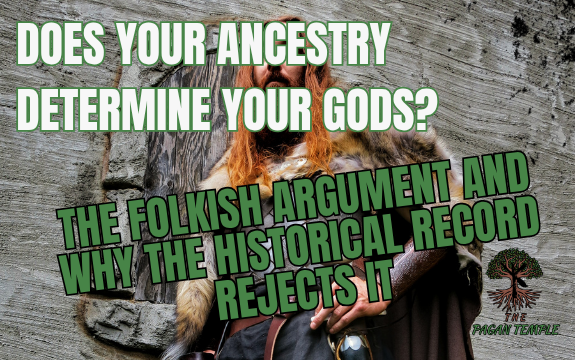

The Asatru Folk Assembly argues that Norse and Germanic paganism can only be practiced by people of Northern European ancestry. Their founding documents describe an integral link between ancestry and religion, between biology and spirituality. This is a specific historical claim, not a theological preference. And the historical record has a specific answer: no. Here is the case, made on historical grounds, against the ancestry argument.
The Folkish Argument, Stated Clearly
The folkish position, as articulated by the AFA and similar organizations, rests on several linked claims. First: that Norse and Germanic religion is the ethnic and spiritual heritage of Northern European peoples specifically, just as Yoruba religion is the heritage of the Yoruba people. Second: that religious practice is most authentically transmitted through ethnic and ancestral connection, and that outsiders practicing these traditions lack the cultural context for authentic engagement. Third, in the AFA’s specific formulation: that spiritual sensibilities are genetically inherited (McNallen’s metagenetics), making race a determiner of religious accessibility.
These claims are made in language that is often careful to avoid the most explicit racist formulations. The cultural heritage framing sounds almost reasonable until you examine what it actually implies. So let us examine it.
What the Historical Record Shows
The Norse and Germanic peoples of the pre-Christian period did not restrict religious practice on the basis of what we would now call race. The evidence for this is not subtle. It is visible in the archaeological record of Norse engagement with multiethnic communities, in the historical record of Norse participation in international trade and political structures, and in the complete absence of any primary source material that describes ancestral or genetic requirements for Norse religious practice.
The Varangian Guard, the Norse mercenary corps that served Byzantine emperors in Constantinople from the 9th through the 13th centuries, integrated fully into a multiethnic imperial military structure. Norse traders in the Volga trade routes maintained regular contact and exchange with Slavic, Khazar, and Islamic communities. The Arabic traveler Ibn Fadlan’s famous account of a Norse funeral on the Volga in 922 CE describes a community embedded in a multiethnic landscape with no apparent anxiety about the religious implications of that context.
Viking Age settlements in Normandy, England, Ireland, and the North Atlantic show evidence of integration with local populations. Norse DNA analysis of the actual population of the Viking Age shows significant genetic diversity, including evidence of admixture with populations across the range of Norse expansion. There was no genetic purity to the Norse people in the historical period, because there was no such thing as a genetically isolated Norse ethnic group.
The Metagenetics Claim
Stephen McNallen’s concept of metagenetics, that religious and spiritual sensibilities are genetically inherited, has no support in modern genetics, neuroscience, or the study of religion. Genetics does not work this way. There is no identified genetic basis for religious inclination, let alone for inclination toward a specific tradition. Religious belief, including polytheism, animism, and ancestor veneration, appears in every human population. No religion has been shown to be genetically accessible only to people with specific ancestry.
The metagenetics claim is not a scientific hypothesis that has been tested and found wanting. It is a post-hoc rationalization constructed to provide pseudo-scientific cover for a racial exclusion policy that preceded it. The policy came first. The justification was invented to make it sound respectable. This is not a charitable reading of the position. It is what the documentary record of the AFA’s development shows.
The Analogy to Indigenous Traditions
Folkish practitioners sometimes argue that restricting access to Norse religion by ancestry is equivalent to respecting the boundaries of indigenous traditions like Lakota ceremony, which are correctly understood as belonging to specific peoples. This analogy fails for several reasons.
Lakota ceremony is a living tradition with continuous community transmission and active practitioners who speak for it. Norse and Germanic paganism is a reconstructed tradition with no continuous institutional lineage. The Lakota people have explicitly set limits on outside participation. The Norse tradition has no living community capable of making equivalent gatekeeping statements, because the continuous community does not exist.
Furthermore, the boundary around Lakota ceremony is maintained by the Lakota people themselves. The social position of those drawing the boundary matters enormously to whether the boundary is legitimate. A living indigenous community setting limits on its own sacred practice is entirely different from white nationalists deciding that only white people can access a reconstructed European tradition.
Who Has the Right to Practice
The question of who has the right to practice a religious tradition is different from the question of who has the right to speak for it. In a reconstructed tradition, what is being practiced is scholarship-based engagement with the historical sources, and the historical sources are available to anyone with the ability and willingness to engage with them seriously.
The Norse gods, based on everything the historical record shows us about them, did not require ancestral credentials from their devotees. The historical practice of this tradition was embedded in specific communities and landscapes, but that embeddedness was cultural and relational, not genetic. You were part of the community because you were part of the community, not because of your DNA.
The serious practitioners of this tradition today, across the inclusive organizations, assess engagement by the quality of scholarship, the seriousness of practice, and the quality of relationship with the tradition’s divine beings and ethical framework. Those are the standards that make sense given what the tradition actually was and what it is now. Genetic ancestry is not among them, because it was not among them historically, and because there is no coherent reason to add it now.